
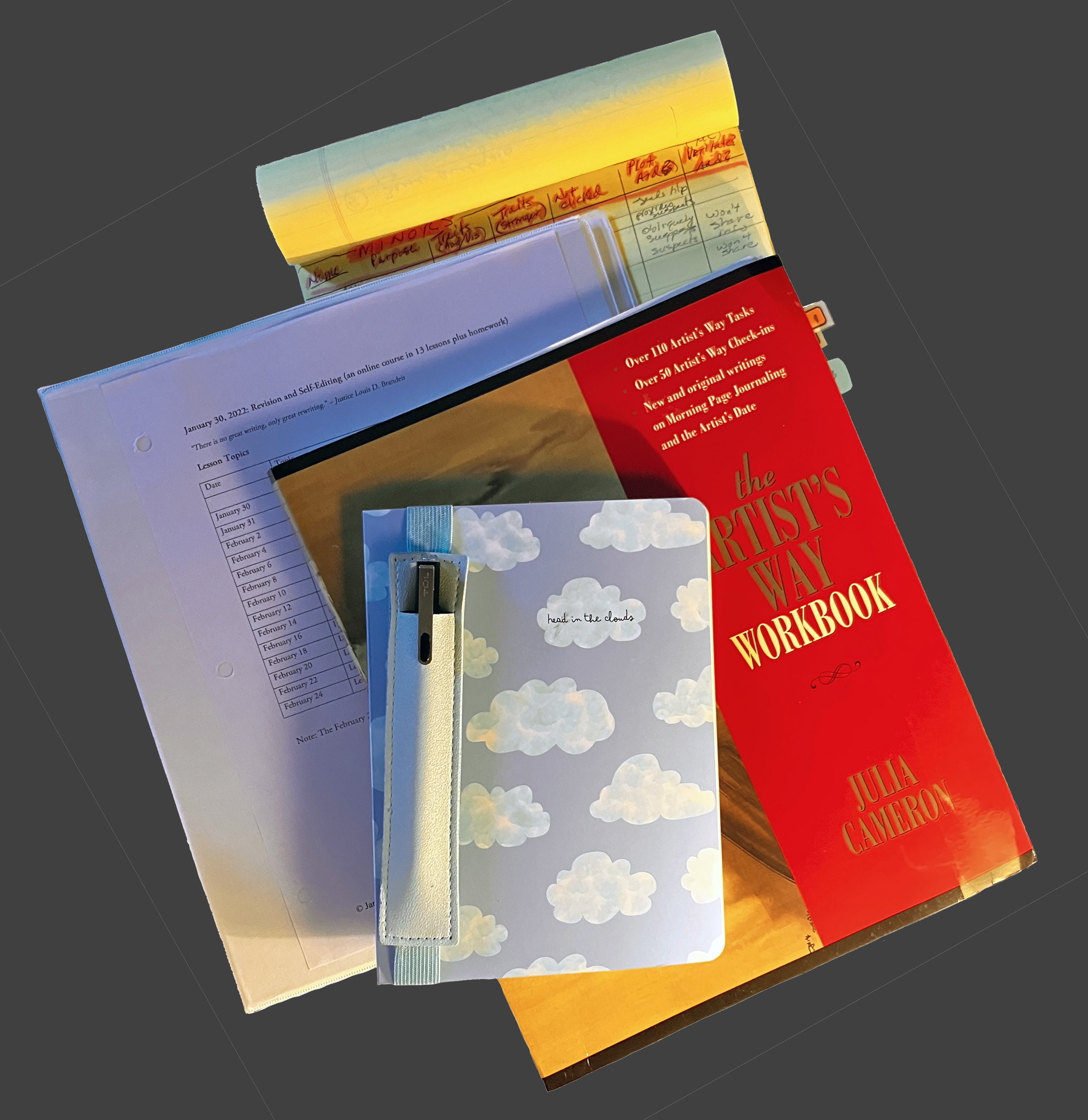
I wandered through January making small “resolutions” as I thought of them. Having got most of my calendars figured out–I’m pretty sure the pocket sized one will get bigger for next year–I started some new projects. About three quarters of the way through January, I decided to get serious about jumping on my treadmill more often. I even bought some colored stars (I guess those gold stars in school really impressed me.), and I have a star on six out of seven days through February. Moving a bit every day is a good plan for me.
I also found The Artists Way workbook that I bought a couple years ago and let sit on an end table in the TV room. I started reading, and I’ve been doing morning pages for a full month! I remember hearing about them years ago from friends who swore by them. But I didn’t really understand the way they are supposed to work until I read the explanation in the workbook. I love the way they help me unload the mind-mess I wake up with. I’ve taken to ending them with a couple–just a couple–of things I want to accomplish that day or the next. I really believe writing one or two daily goals made me more productive. I certainly feel more productive this month.
I will say some of the thinking of Julia Cameron, the author of what I’ve taken to abbreviating TAW, was initially off-putting to me. She speaks in a language of recovering: recovering a sense of safety, of identity, of power, and so on. To me recovering implies a loss, or a sickness of heart. But when I substituted discovery for recovering, the book felt much homier and welcoming to me. I think I’m discovering more of the artist inside that I’ve always know was there, but that I didn’t give time to because I was busy working and trying to be a good mom to my kids. Now that I’ve retired, I feel like discovering the potential I’ve left dormant for decades.
I haven’t done as well on the solo artist’s dates as I might. That’s partly because my schedule is already so full. I have writing groups six days a week, three book clubs every month, plus a couple of study groups, the League of Women Voters, and a social gathering or two. And I feel that many of those events feed the artist in me without going it alone. I’ll try to fit in some of the prescribed dates, but I’m not too worried about that.
And the other thing I started doing was working through a revision course I took four years ago through the Sisters in Crime Guppy chapter. Our former president Jim Jackson taught the course. (He teaches three and I’ve taken them all.) I used the same novel I’m working on now for the course, but I knew I wouldn’t be able to focus a lot of attention on it because my “big volunteer job” started about half way through the course.
I kept every note, though, and I printed them out at the end of January and started with the first step–rereading the entire draft. This time, I learned so much more than last time! With nothing competing for my time and attention, I was able–finally–to discover that I won National Novel Writing Month (NaNoWriMo) with the first draft because, as a pantser, I just wrote words as they came to me. The point of NaNo was to get 50,000 new words in the 30 days of November. I did that the year I drafted this novel, but only because I wrote whatever came to mind at any given writing session.
Reading through this time, I realized how much is way out of order, how much is backstory and info dumps that don’t need to be in the story, and where the big and small plot holes are. I also made a list of all the scenes in the book. I got into the early triple-letters (AAA, BBB, etc.). I’m working on my list of minor characters as I close out February. Because I wrote them as I thought of them, in previous revision attempts I fixed some minor problems without fixing the big ones. As soon as I finish the “character census,” I’ll make a new scene chart and put the scenes in the right order and start by fixing the plot problems
I can’t believe how much fun I’m having finding the problems in the story. And knowing I’m building a strong plan for my revision.
I’m not so foolish as to believe I’ll be creating a “perfect” draft this time around, but I think it will be good enough–with help from my critique partners–to try to shop it to an agent again. I really wasn’t ready for the pitch in October, but I wanted to give it a try. She, rightly, declined it. But the pitch was great for practice and I know the general outline of the plot and characters are good, or she wouldn’t have told me to send her pages. One of the big changes that will come in this draft is losing a good chunk of the very beginning of the story. Maybe I’ll have good luck next time, too.
A bientôt!
 sharon p. lynn