
Red and gold leaves, yellow corn stalks and orange pumpkins are the colors we typically think of in autumn.
But on a road trip this month, I decided to take a break — and a walk — at the National Quilt Museum in Paducah, Kentucky. And there, I fell into the blue end of the rainbow.
I’d passed by the signs for the museum a few times before and I finally followed them in April. It seemed to me that by November exhibits would have changed. And I was right.
I love wandering around the halls of the museum, stopping to admire the designs and the stitchwork in so many of the quilts. The museum is dedicated to contemporary quilts, though some are traditional looking and others quite modern. These crafters consider fabric their art medium, and they express themselves in unusual ways.
I saw a few familiar quilts from the permanent collection, and there were, as I suspected, a few holiday pieces on the walls. But they weren’t the dominant theme. In November, the primary displays included works of a married couple, as well as a mother-and-daughter pair of quilters. Quilts by an individual artist filled one room, while another featured the work of the museum’s “Block of the Month Club,” and the largest hall was devoted to a show by a group of quilt artists.
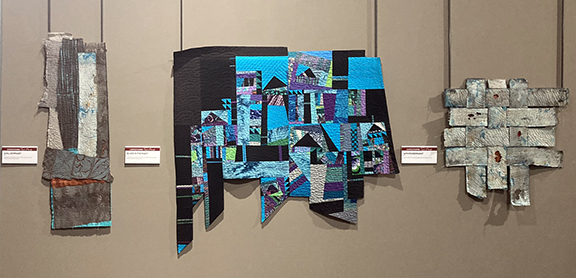
Detroit fabric artist Carole Harris’s work, including the three at the top of this post, comprised an exhibit called Time Pieces. The quilts are (from left) Wall Remnant, Blues in the Night, and Woven Remnant. She explains on her website that her work “relies on improvisation. I am fascinated by the rhythms and energy created when I combine multiple patterns and textures. I let the material and colors lead me on a rhythmic journey.” I believe this exhibit closed in November, but you can see some of her art on her website.
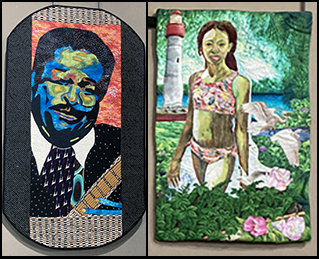
The mother-and-daughter team of the Black Renaissance exhibit are Lola Jenkins, mother, and Precious Caroll, daughter. Their creations, remaining through early March 2024, include a lot of small quilt portraits of famous and ordinary people. Lola Jenkins’ colorful portrait of BB King and Precious Caroll’s young girl in, “Lighthouse by the Tree,” are just two examples of their work. Most of their quilts are roughly the size of a small painting and I can imagine them mounted on a wall behind a couch or in a bedroom.
Jenkins, on the quilt museum website, says, “Using fabric as paint helps me to understand and express my feelings and … helps to make me feel whole.” Carroll, also on the website, explains she moved from Delaware to Nebraska “with the primary focus to learn my mother’s quilting techniques… .”
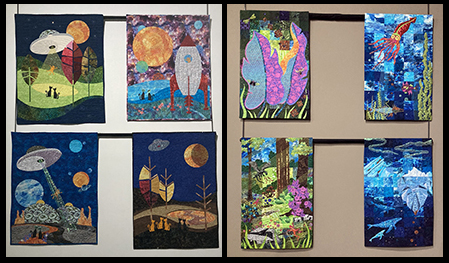
The other team — wife Jean Brueggenjohann and husband James Reese — also create smaller pieces, but draw their inspiration from natural and imagined worlds. Brueggenjohann uses traditional quilt piecing techniques to lead viewers through stories. Reese previously worked with metals or in digital media, seels his fabric images and playful mixes of color, pattern and design to create stories. Their show called Divergent Paths — Altered Realism & Abstraction will also be featured at the museum through early March.
The images of Reese’s four-part story, clearly science fiction in nature, are called (from far left, top to bottom) “They’re Back!,” “Where No Cat Has Gone,” “They’re Here,” and “They Don’t Stop Anymore.” These quilts are all from 2023.
Brueggenjohann makes scenes from nature in her 2022-23 quilts “The OtherWorld” (from mid left, top to bottom), “The Garden,” “The Sea,” “The Forest” and “The Polar Night.”
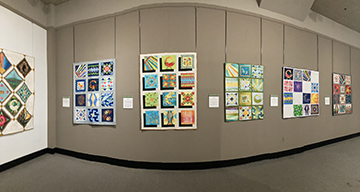
One of the smaller galleries included quilts that are part of the museum’s “Block of the Month Club.” Quilts from Round 4 of the challenge, in my “panoramic” shot illustrate the interpretations quilters gave to the theme. They were scheduled for exhibit through early December. And there were lots of blues.
The theme for Round 5 is Exploration/Exploring/Explore. Seeing these quilts made me wish I knew how to sew. But I started thinking about ways I might be able to mimic the look in the needlecraft I know–crochet. We’ll see. But for folks with actual quilting skills, check out the challenge on the museum website.
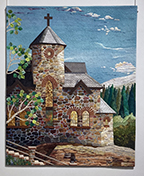
Another blue that caught my eye was Annette Kennedy’s “Mountain Chapel” from 2008. It was one of the more traditional in appearance, but I guess the Longmont, Colorado, resident might have been influenced by views near her home.
But the exhibit that I found most fascinating on this trip was the exhibit from Studio Art Quilt Associates titled “Primal Forces: Wind” that will remain through Jan. 9, 2024. Not only was it full of blues, it also featured a huge variety of fabrics, quilting styles and interpretations of wind.
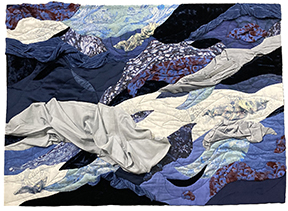
Dorothy Raymond of Loveland, Colorado, created the free motion, appliqued quilt she called “Turbulence” (left) in 2022. Signs in the museum remind visitors not to touch the quilts, but I had a hard time keeping my hands off the silks, cottons, wools and other fabrics of “Turbulence.” The quilt created for me a sense of waves rippling wildly across the surface of an ocean, and I wanted to dip my hands right into the “water.”
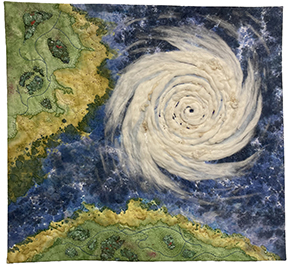
Victoria Qutierrez of Reno, Nevada, created “Winds of Change” (right) in 2022. Can’t you just see the hurricane approaching the sandy beaches and forested shores of two islands? That’s what I see in the cotton, rope, wool roving, Angelina fiber and glass beads in this quilt. It is so much more vivid than any of the weather maps that illustrate these massive storms.
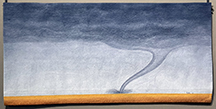
As a Midwesterner, I couldn’t help being sucked into Cat Larrea’s “Tornado” (left) from 2022. The hand-dyed cotton quilt with fused applique makes me want to head to the basement. I was surprised to learn that Larrea is from Anchorage, Alaska.
There were so many beautiful images in this exhibit I could find dozens more to share, but enough is enough. If you happen to be passing Paducah on any road trips in the next few weeks, I encourage you to follow the signs to the National Quilt Museum and see them for yourself.
In fact, I urge you to do as I’ve done: Make it a regular stop in your travels. There will always be something new to see.
 sharon p. lynn