It’s the first in my focus on crime fiction, broadly defined. I also developed my own five-gun, violence-rating system, in case that influences your reading choices.
While I was in Appleton, Wisconsin, earlier this month, I met two women crime fiction writers from New Zealand and England. (But that’s another story.) Neither had a car, so I took them to a couple of places they wanted to visit. One was a shooting range. The other was the Experimental Aircraft Association museum in Oshkosh.
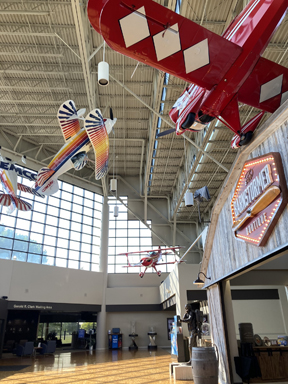
At the EAA museum, we went our separate ways to explore the huge museum and its many exhibits. I was surprised to find two areas of tribute to women aviators. There may have been more, but we only had about an hour to spend, so we kind of flew through. (No pun intended.)
One of the areas was dedicated to the history of the women called WASPs, variously defined as the Women Airforce Service Pilots, Women’s Army Service Pilots and Women’s Auxiliary Service Pilots. (There’s a bit of history at https://www.worldwariiaviation.org/women-air-force-service-pilots-wasp.) Posters showed the history of their service, and some of the things they did during World War II. There was also an example of their uniforms.
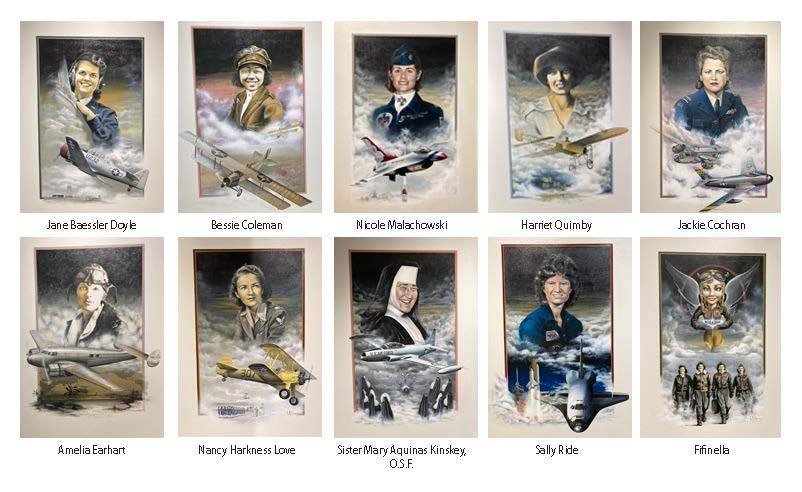
Another area was a walk-through portrait gallery. With these ten women (portraits with this post) were some of the men who contributed to aviation history. Sure, I knew about Amelia Earhart and Sally Ride, and I just learned about Bessie Coleman. But the others were new to me.
Roald Dahl wrote about fifinellas in his 1942 book, Gremlins. They are, he explained, female gremlins who plagued the pilots of the Royal Air Force. Walt Disney illustrated the book and developed the first image of a fifinella. The one at the EAA museum looks different, but her story is the same.
Disney and his empire are picky about the use of their illustrations, but in what I can only assume was generosity borne of the war effort, he allowed his original drawing in the Fifinella Gazette, the WASP newsletter, and to be used — for at least two years — as the official mascot of the WASPs. The initial permission could be renewed upon request.
Another surprise to me was learning about Nancy Harkness Love, who was a civilian in the Army Air Force. She commanded the first units of female pilots during WWII. She earned her pilots license at age 16, after she saw Charles Lindbergh and the Spirit of St. Louis in Paris. (He has a section in the EAA museum, too, and there’s a replica of his plane in the exhibit.) Nancy, who later became a Lieutenant Colonel in the Women’s Airforce Service Pilots, earned a commercial pilot’s license in 1932. She flew people around the U.S. Northeast to earn money while a student at Vassar College.
Despite her work, she had to leave college after her junior year because she and her parents couldn’t afford it. She took a job selling aircraft in Boston, then worked as a test pilot for industry and for the Burea of Air Commerce (today, the Federal Aviation Administration).
She also flew across the country to try to convince communities and farmers to paint navigational signs on water towers and barns to improve flying safety.
(Sharon’s photo)
If you plan to visit the Oshkosh area, this is the 75th anniversary of the EAA. That makes it a great year to consider attending the annual Airventure. I think it’s probably the biggest “family reunion” of pilots and flying afficiandos in the world. Check it out at https://www.eaa.org/airventure.
And be sure to make a stop at the museum. I plan to go back.
(Montgomery Art Museum exterior from https://mmfa.org/; others are Sharon’s photos)
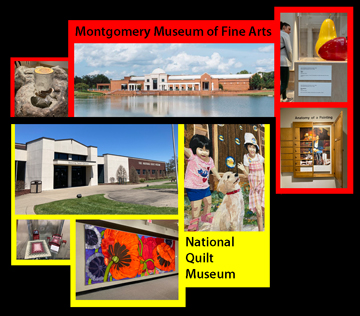
When I go on trips, I love to stop at museums. On my trip this month, I had my first visit to both the art museum in Montgomery, Alabama, and the National Quilt Museum in Paducah, Kentucky. Each is a tiny gem of a museum.
The art museum has a variety of media — both two- and three-dimensional. It’s a favorite of my almost-three-year-old grandson because of the many activities in an interactive children’s area. One that I liked was the Anatomy of a Painting. Opening sliding panels reveal the steps of the painting from an underlying sketch to the final layer of color. There are also a variety of building blocks, sketch tables and other art treats he and older children can enjoy.
A blown glass exhibit included a bright yellow pear, a seed-speckled strawberry and a purple plum by artists Joey Kirkpatrick and Flora Mace. Another exhibit featured the work of Ginny Ruffner, working with Grant Kirkpatrick — both based in Seattle, Washington. From an apparently bleak landscape of glass tree stumps sprout floral oases. This is one I wish I’d had more time to stroll through.
Admission is free, but be as generous as you can with your donations.
(Justin Ming Yong’s work; Sharon’s photo)
The National Quilt Museum is one I’ve wanted to visit for several years. No, I don’t quilt, but I admire those who work in this fabric art form. The museum has hundreds of quilts in its collection, but the building is too small to display them all at once. That’s an advantage, though, because it means there will likely be something fresh every time you stop.
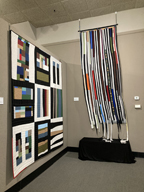
One of my favorite exhibits was by Canadian artist Justin Ming Yong who works in abstract forms. His show in Paducah, “To Fill a Field,” appears to be on loan from the Toronto Arts Council and funded by the city of Toronto. I was enthralled by his work.
Some of the other exhibits featured traditional quilts, quilted garments, and miniature quilts displayed in doll-house sized rooms. A quilt mural of poppies was so large it reminded me of Monet’s water lily paintings at L’Orangerie museum in Paris. And the quilts of children playing were so detailed, it was easy to forget they were “painted” in cloth.
There was a small admission fee, but well worth it for the opportunity to enjoy so many amazing quilts.
I’m afraid I wasn’t able to walk away from either without a few purchases at their gift shops. Looking forward to my next visits.
I finally made it past the programs and other materials I’ve been working on all March. And I managed to squeak over the finish line in a class I took on self-publishing.
I’ve grown up imagining seeing my books on the library shelf. “The” library was always the one in my home town, the one where I spent a lot of my spare time as a kid, the one where I got my first job.
But my first full time job — at my hometown newspaper — conditioned me to expect to hear presses run minutes after the last story landed on the last page. Not an ideal expectation for someone seeking a traditional book publishing experience, where the day you type “the end” can be years before the day you open the box with the finished copies of the book from the publisher.
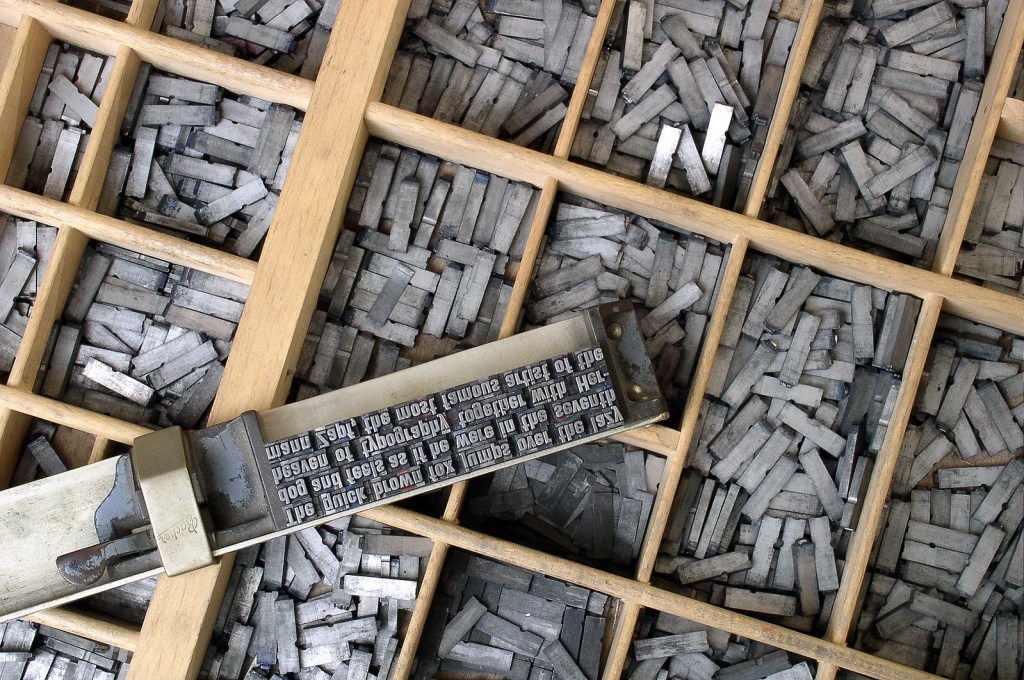
I know more than most, I suppose, about the printing process. I even took a printing class when I was in college. I loved setting type and working hand-fed presses. But that’s another story.
I’ve waited so long to devote time to writing fiction, that I have my doubts about being able to wait patiently for that traditional book publishing cycle. And I haven’t even looked for an agent yet (although I’ve had a couple encourage me to send them something when I finish the book).
So, the class in self-publishing was led by Jim Jackson, a past president and past member of the Sisters in Crime Guppy Chapter. The Guppies are “the great unpublished,” although the name is a misnomer since many members stay in the chapter after they’re published, sharing what they’ve learned with the rest of us who haven’t reached that lofty stage yet.
Jim taught a great class on revisions last year. It was intense, but amazingly organized and detailed. I loved it.
When I heard he was teaching one on self-publishing, I new it, too, would be well-planned, well-researched and, well, amazing. I figured it would be the ideal way to get all the facts so I could make a good decision about whether to keep trying for a traditional contract or just go it alone.
I haven’t made my final decision yet, but I do feel well-prepared to make it in the next few months.
Even though I’m still what we call a “pre-published author” in the crime fiction business, right now my life seems to be all about awards.
A year ago I offered to create the program for Malice Domestic, an annual conference where fans and writers of mysteries gather for several days to talk, drink tea, and vote on the Agatha Awards. Yes, they are named in memory of the Dame herself, Agatha Christie.
I’ve put in about a day and half already this week on photos, email, and page designs. Others on the committee are also hard a work writing stories, setting up the sessions, designing ads, and doing countless other tasks that happen behind the scenes to make sure people who attend have fun while they’re there.
The Agatha Awards are hand-lettered tea pots, some black, some white. They suffered a few supply chain problems during the height of COVID, but it looks like the supply is back to normal now.
:Last week, I got my invitation to the Edgar Awards. Everyone who is a member of Mystery Writers of America is eligible to attend the ceremony — black tie, it is — in New York in April. I won’t be going, in part because it happens days before Malice begins, and I’ll be busy in Maryland. The award is a colorful bust of the man considered by many to be the father of mystery fiction in the U.S.
And today, amidst all the Malice email that’s been landing in my box, I also received my invitation to nominate stand-out books from 2022 for the Anthony Awards. I’ve only been to Bouchercon, where the Anthony’s are presented, twice. I tried to go more since my first trip to Toronto a few years ago, but, well, COVID.
I managed to join thousands of others in Minneapolis for what is the biggest mystery conference in North America. That’s where they awarded the clear plaque for the first time. The conference and the award are named for Anthony Boucher, who was both a critic and a writer of mysteries. Boucher was actually a pen name of William Anthony Parker White.
And I need to take a look at my 2022 reading list on Goodreads to pick out things I might want to nominate for the Anthony’s. I’m already reading the nominees for the Agatha Awards, since I get to vote on those, too.
So, contests. They’re taking a lot of my time lately. And maybe someday, I might even have a book that’s eligible