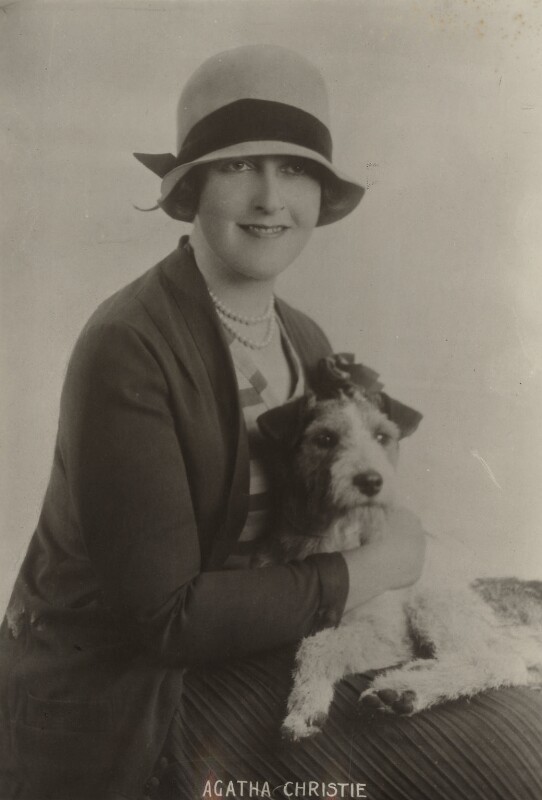
But as it winds down, it the perfect time to offer kudos to my friends who are on the lists for short story awards this spring.
At Malice Domestic 36 — which begins with pre-conference activities April 25 and opens officially April 26 — there are five nominees in the Best Short Story category. There are links on the website’s Agatha Awards page if you want to read the short stories. There are also links at malicedomestic.net for general information (include late registration).
The Derringer Awards (could there be a better name for a mystery short story award?) came out on the last day of the month. Check them out on The Short Mystery Fiction Society Blog. The categories there are Flash, Short Story, Long Story and Novelette.
And in my own short news, I submitted a short story to an anthology. Fingers crossed, it gets picked. I’ll let you know.
That’s what we do in the new year, right? We start fresh with a new calendar. We try to make this year “count” in some way that previous years haven’t.
I’ve always tried to give some of my time to volunteer pursuits, mainly by taking positions on various non-profit boards. And, thinking back, I’ve always taken the same kinds of roles — the ones that help with publicity or communication. These days, that tends to involve social media.
But since I’m mostly retired, I’m up to six groups. I counted the other day. (Stop me before I volunteer again!) Their demands vary, and one only needs attention from now until the end of April. But it needs a lot of attention.
Another needs a record of the hours its volunteers serve. In order to be eligible to vote at the annual meeting, volunteers must have provided at least 10 hours of service during the previous year. And the organization needs records of that service, not just to keep track of its voting members, but also to include in grant applications.
So, my new habit involves a timesheet — my new habit. I made a spreadsheet to help me keep track of the hours I’m spending for each group. I didn’t make it until Jan. 8, so I missed whatever I put in on the first week. That’s ok, because I didn’t do anything for the group that wants records until the day I started it. (And I need to give them a bit of time today.).
Since it’s all on the honor system, I’m rounding to the nearest quarter hour for all the groups. I hear that works for lawyers.
And I’ve been diligent since that first day.
I added it up yesterday and I’ve put in 51.75 hours of volunteer service to five of my six groups in the past two weeks. (The other one won’t meet until next week.)
But I also added a column for writing and revising. So I also learned that, until yesterday, I’d only put in 3 hours towards my novel. That’s no way to get revisions done.
I doubled the time yesterday. I focused on my revisions and spent 6 hours on them. That has to improve.
So, my new habit — my timekeeping — is already teaching me things about the balance in my life. And led me to my next goal, which is to make sure I get some writing and revising time in at least five days a week.
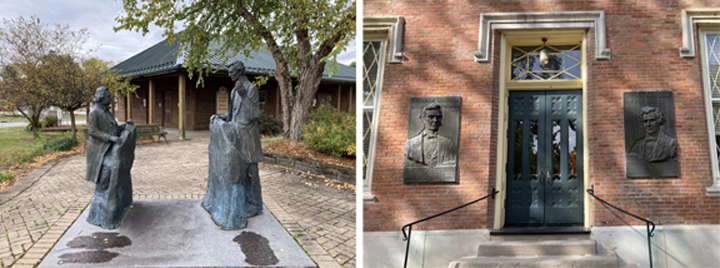
Charleston (left) and Galesburg, Illinois, debate sites. (Sharon’s photos)
A couple of months ago, after I finally took a few photos of the first Lincoln-Douglas debate site in Ottawa, Illinois, and the second one in Freeport, I said I was going to put the seven sites on my “to visit” list. Well, I ticked off two more this month on the way home from a southern road trip.
(Sharon’s photo)
I stopped at Charleston, site of the fourth debate, and Galesburg, site of the fifth debate. No, I’m not taking them in the order they happened. This was the order that worked for my route back home to northern Illinois. I figure I’ll try to do three, six and seven on my next trek south.
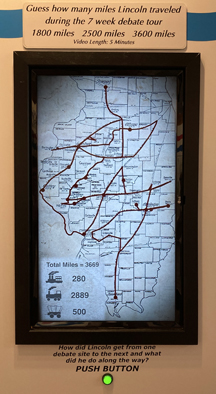
And I don’t expect to log as many miles as Lincoln did while he was on the debate circuit. There’s a map of the whole route, including details about how many miles Lincoln covered via train, boat and wagon at the Charleston museum. (Apparently Douglas didn’t keep track as closely.)
My only advance research for the sites was finding them on my GPS. I was expecting small parks, like the surroundings of the two sites I’d already seen. Each of those has some relatively new signs explaining what went on back in 1858. But neither of these sites is in a park.
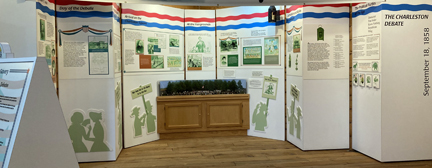
Charleston’s debate site is at the Coles County Fairgrounds, and its statues of the debaters are the most accessible of the ones I’ve seen so far. They stand at the corner of a little museum that features some hands-on exhibits, as well as a little theater that shows a short film at the press of a button.
(Sharon’s photo)
The political nature of the debates is clear, with red white and blue bunting and colors throughout the room. But the location was considered especially friendly to Lincoln, where his stepmother, Sarah Bush Lincoln, and other family members still lived. The local hospital bears her name.
(Sharon’s photo)
In Galesburg (also the home of Carl Sandburg, but that’s another story), the debate was held outside Old Main, a building that was finished in the summer of 1857 on the campus of Knox College. There are no statues to commemorate the debate, but on the east side of the building large, bronze plaques of each candidate frame doorways into the building. (The handicapped entrance is on the west side of the building.)
Inside along the hall, several signs and photos illustrate the history of the college, as well as the significance of the debate. And in a small room on the left from the debate doorway is the Lincoln Chair room. The chair is the one Lincoln sat in while waiting for the debate to begin.
(Sharon’s photo)
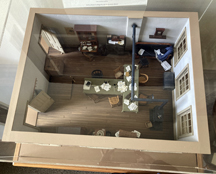
The room also houses a collection of memorabilia from the debate, as well as from the life of the 16th president. Across from the doorway sits a detailed miniature of the law office Lincoln shared with William H. Herndon in Springfield, Illinois. There are also a variety of images — posters, photos– and a small statue of Lincoln on a bookshelf.
Historical note:One of Knox College’s graduates was Hiram Rhodes Revels, who would become the first African-American U.S. Senator and the president of Alcorn University in Mississippi.
To the left of the miniature, is the window Lincoln and Douglas climbed through to reach a platform that was built for their debate. It blocked the door between the plaques, making the window the only access for the debaters. The effort, according to a small sign near the window, led to Lincoln’s remark, “At last, I have gone through college.”
Last December I agreed to volunteer some time to do a little desktop publishing. I anticipated the job would take about a month, based on experience with similar projects. Who knew I’d end up putting in about three weeks of that month in ten days!
Part of crunch was my own fault. I went on a week-long vacation with my sisters. We didn’t do much, but it was our first get-together in nearly three years. But traveling in the middle of the project made me nervous. And I didn’t have all the materials from other volunteers before the trip.
I got home, dug in and managed to make the printer’s deadline. And I had a little fun along the way playing with pages. But I really hated cramming so much into so little time. I wanted the finished product to look nice. I wanted it to be accurate. And the rush made me change my goal simply to getting done.
Oh, sigh.
There were mistakes, and while at the moment we’re trying to find them and fix them for the online version of the program, the original printing will always have them. Corrections are coming along, but I’m about to hit the road for another conference — the Writers’ Police Academy, this year in Green Bay and Appleton, Wisconsin. It will be my third trip, and I’m looking forward to it.
And, when I get back, I’ll be making the final corrections to the program. Fingers crossed next year goes better.