
Article: Ray Bradbury on Writing, Emotion vs. Intelligence and the Core of Creativity
Ray Bradbury on Writing, Emotion vs. Intelligence and the Core of Creativity
http://www.brainpickings.org/index.php/2013/08/22/ray-bradbury-day-at-night-1974-interview/
It’s a World of Words Book Fair
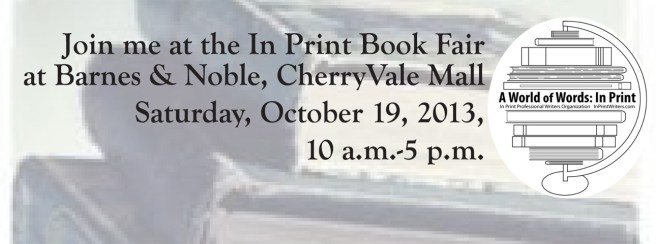
Come for guest authors, readings, panel discussions, book signings and more.
Click on the image for details.
Lessons from the dust of Beautiful Ruins
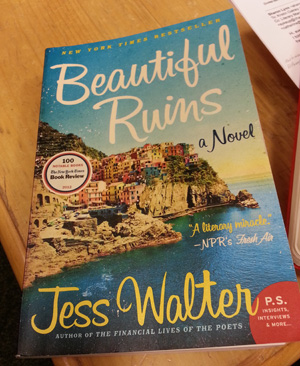 Last month most of the members of our In Print Writers as Readers book discussion group said they had no trouble finishing our selection – The Language of Flowers. This month several writers admitted they kept reading Beautiful Ruins just because it was our selection of the month. For several, it was a chore, not a treat.
And yet, when we started talking about it, we realized author Jess Walter had shown us much worth discussing.
Walter’s novel about the intersections of several lives during and after the making of the movie “Cleopatra” was less than straightforward in its style. Its constant structural changes sometimes amused and sometimes annoyed members of the group.
The novel opens in 1962 like this:
The dying actress arrived in his village the only way one could come directly – in a boat that motored into the cove, lurched past the rock jetty, and bumped against the end of the pier. She wavered a moment in the boat’s stern, then extended a slender hand to grip the mahogany railing; with the other, she pressed a wide brimmed hat against her head. All around her, shards of sunlight broke on the flickering waves.
We agreed that the Walter’s prose style immediately brought to mind the era in which the opening scene was set. And that’s where some of the group took a deep breath and settled in for a nice long read with descriptions and pace that evoked the people and places of half a century ago. Others, though, just slogged along, determined to get through what seemed destined to be a conventional, literary novel.
In the rest of the chapter, we learned a bit about the actress Dee Moray and more about Pasquale Tursi, who “watched the arrival of the woman as if in a dream. Or rather, he would think later, a dream’s opposite: a burst of clarity after a lifetime of sleep.”
But when we got to chapter two, our readers seemed to move to the opposite sides of the appreciation/toleration coin. Here’s a sample of that chapter:
Claire wakes jonesing for data; she fumbles on the crowded bedside table for her BlackBerry, takes a digital hit. Fourteen e-mails, six tweets, five friend requests, three texts, and her calendar – life in a palm. General stuff too: Friday, sixty-six degrees on the way to seventy-four. Five phone calls scheduled today. Six pitch meetings. Then, amid the info-dump, she sees a life-changing e-mail. From affinity@arc.net. She opens it.
Walter takes us instantly into the 21st century. The changes – from old-school, almost languid prose to rat-a-tat delivery, from sleepy Italy to speedy Hollywood, from past tense to present – jarred nearly everyone. And these weren’t the only sudden changes in the novel’s style and structure.
I picked this novel for us to dissect specifically because I was interested in how Walter handled the long time frame. We agreed that his approach was unexpected and, for some of us, less than enjoyable, but it was effective. There was no question that we knew where we were in the timeline between 1962 and 20-something in most chapters.
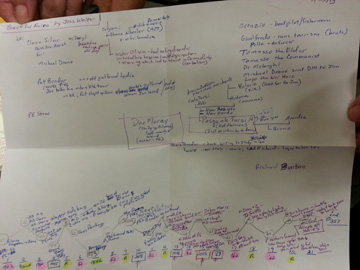
We also agreed that Walter was able to paint distinct pictures of most of the main characters. And there were lots of them in different places and times. One of us, among our visual thinkers, created color-coded charts to help her keep track of people and places.
Another launched a short discussion when she mentioned how much she disliked Michael Deane, a Hollywood producer today and a “fixer” in the 1960s. We agreed quickly that our dislike was an indication of Walter’s success in describing Deane physically – “The first impression one gets of Michael Deane is of a man constructed of wax, or perhaps prematurely embalmed.” – and psychologically – he agrees to promote a script he knows the studio will reject just so he can use the rejection as a way to get out of his contract.
The book is billed as humorous, but the humor escaped several of us. And when we saw it, it was generally of an ironic or sarcastic nature. Some drew parallels with Kurt Vonnegut, Joseph Heller, Carl Hiaasen or Christopher Moore.
There are several love stories – or lack-of-love stories – in the novel. So, was love a theme of the book, we wondered. We concluded there are certainly examples of familial love and responsible love, as well as “it’s depressing and people suck” love and time- and obstacle-conquering love.
We had mixed feelings about whether we would recommend the book. Despite agreeing that Walter has a gift for description and character development, we also agreed that the jarring format he used to “travel” through time and space just wouldn’t appeal to everyone.
Are we glad we finished it? Yes.
And we think we’d like to see the movie.
Patience
“I can’t believe Becky even said,” that, Miriam growled, slamming her books onto her desk in the dorm room. “I mean, what business is it of hers whether I go out with Dick?”
“Slow down,” her roommate Sandy said, surprising herself when she realized she was waving her hands in the air, as if she could somehow slow Becky’s tirade that way. “What did you say she said?”
Becky paced the four open feet between the desks. “She said I might want to be careful before I got too involved with him. “
“Why?”
“I have no idea. She said she didn’t want to talk about it, but she knew he’d done something awful to another girl he went out with.”
“So, you’re saying she never actually went out with Dick herself?” Sandy asked.
“No, she didn’t,” Becky responded. She finally plopped down on the edge of the window sill, her back to the palette of fall leaves that colored the entire campus. “So, what difference does it make to her?”
“Well, maybe she’s jealous. Otherwise, why would she even pay that much attention to him?”
“Maybe. I don’t know. What do you think I should do?” Becky asked, sounding a little dejected.
“Well, as the bard said, ‘All the past is prologue,” Sandy said. “Or, as Scarlett put it, ‘Tomorrow is another day.’ Guess you just need to wait to see what she – or he – does next.”
 sharon p. lynn