Today marks the Lunar New Year — the first day of the Year of the Dragon — a year I find personally auspicious. It’s my year, after all.
I was born in the Year of the Dragon — I’m old enough not to go into details — and I always look forward to my own year in the Asian zodiac. You might say, I’m “fired up” about the New Year. (Don’t groan too loudly.)
This year, especially, since I effectively took January off for an extended visit with family and friends, I really feel like now is the right time to start a new year.
I’m ready to set some goals. Outline some projects. Block out time on my calendar. Start fresh.
Since Feb. 10 is also the feast day of Blessed Alojzije (Aloysius) Stepinac of Croatia (learn about him here), it seems fated that I should talk about some New Year’s traditions from my Croatian side.
Yes, the dragon represents the Asian year. But the pigs with their gold coins represent an old Croatian tradition.
First, though, you should know that in Croatia (a country known for its potent plum brandy), people believed that the way you behaved on New Year’s Day would set the tone for your entire year. Ideally, you should have a neat house and everyone in it should be quiet and well behaved all day. That may have been due to overindulgence in plum brandy the night before, but I can’t say for sure.
The main course, if possible, was pork on New Year’s Day.
They didn’t eat chicken, because chickens move their feet backward as they scratch the soil. Having chicken on your table could bury all the year’s good fortune.
They didn’t eat rabbit because the timid creatures run away, carrying good fortune with them.
They didn’t eat fish because they swim away from you, prosperity slipping away in their wake.
They did eat pork because pigs, when they root around for food, dig forward. As they uncover treasures to munch, they also uncover heaps of good fortune for the new year.
So put some pork on your table tonight and enjoy the fortune of fresh, new year!
Now that I’m moving into my third year of “mostly retirement,” I’ve finally realized I’ve been keeping myself nearly as busy as I was when I worked full time.
But I don’t have to.
Last January, I resolved to start a new timekeeping habit. I’m glad I did. I’ve already added a page to my spreadsheet for 2024.
My first year as a personal timekeeper wasn’t perfect. I missed whole weeks — many of them while traveling to and from a variety of writing conferences. I also didn’t keep great records when I tried to squeeze in a little writing time while on family trips. Then I lost a couple weeks toward the end of 2023 when I caught the worst cold I’ve had in years! I can’t remember the last one that sent me home to bed. (I tested; it wasn’t covid.)
But I learned a lot from the incomplete data that I managed to collect. (I do love data.)
First, I have to cut my conference attendance. They are tons of fun and I love seeing old friends, making new ones, and learning tricks of the writing trade. But I’ve decided I can only do one writing event in 2024. Going virtually cold turkey will be hard, but I have to do it.
I’ve also known for a while that I was over committed to volunteer projects. Especially ones that play to the strengths I developed over years of working. I’ve always been taught to give back, and once I stopped working full time it seemed like there was more time to give.
But a couple of volunteer roles that were simple when I took them on developed “project creep” when other board members dropped out. Things still had to get done.
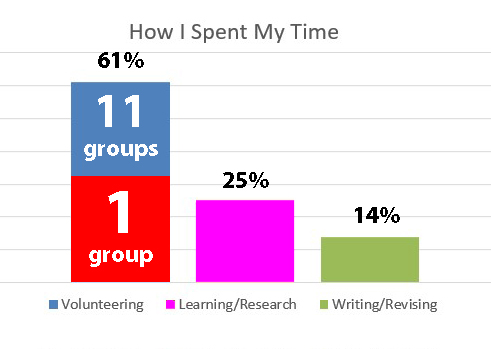
And there was one role I stepped into a few years ago that didn’t give me a full “job description” when I said yes. I’ve since discovered that other board members took on some of the tasks no one mentioned to me. And I learned “on the job” about other expectations I wasn’t prepared for. That one group consumed more than half of my “volunteer giving” hours in 2023.
The other 11 groups I helped in 2023 took slightly less than half of all my volunteer hours last year. One “group” is my former full-time employer, which still asks me to fill in from time-to-time. I tote it up with the volunteer time because I could say no. (But they still pay me, so I say yes.)
While I willingly agreed to do more “for a while” when board compositions changed, “a while” is over.
I’ve already finished my commitments to two of the 11 groups. The terms I committed to range from a year, or two, or three, to indefinite. I’m giving some serious thought to resigning from a couple others. And you can bet I’m counting the months until I finish my term for the major time-sucking organization (TSO).
I did a quick calculation of how the percentages would have looked without that TSO in 2023. I’d have had 43% in volunteer time; 36% in learning and research; and 21% in writing and revising. That’s still not where I want my writing time to be, so I’ll have to trim more of the volunteer time.
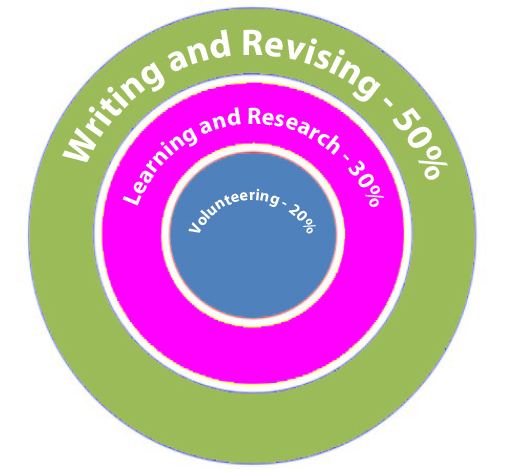
My goal for 2024 is 50% of my time in writing and revising, 30% in learning and research, and 20% in volunteering. That’s one day a week in “work hours.” I think that’s still pretty generous. And I think I can do it.
Just remember, if you ask me to do anything in 2024, don’t be surprised if I just say NO! Don’t take it personally. I still love you and your organization. But I really want to finish some of the writing projects that I’ve dabbled with for decades.
And I won’t even mention all the stuff around the house that I haven’t done because of everything else. But that’s another story….
I’ve added short reviews of several holiday-themed cozy and traditional mysteries. They’re great for curling up with hot chocolate this time of year.
I’ve included books from Donna Andrews, Rhys Bowen, Kate Carlisle, Agatha Christie, Vicki Delany, Francis Duncan, Joanne Fluke, Jacqueline Frost, and Charlotte MacLeod. And, despite putting them in alphabetical order here, they aren’t quite that way in my reviews.
Red and gold leaves, yellow corn stalks and orange pumpkins are the colors we typically think of in autumn.
But on a road trip this month, I decided to take a break — and a walk — at the National Quilt Museum in Paducah, Kentucky. And there, I fell into the blue end of the rainbow.
I’d passed by the signs for the museum a few times before and I finally followed them in April. It seemed to me that by November exhibits would have changed. And I was right.
I love wandering around the halls of the museum, stopping to admire the designs and the stitchwork in so many of the quilts. The museum is dedicated to contemporary quilts, though some are traditional looking and others quite modern. These crafters consider fabric their art medium, and they express themselves in unusual ways.
I saw a few familiar quilts from the permanent collection, and there were, as I suspected, a few holiday pieces on the walls. But they weren’t the dominant theme. In November, the primary displays included works of a married couple, as well as a mother-and-daughter pair of quilters. Quilts by an individual artist filled one room, while another featured the work of the museum’s “Block of the Month Club,” and the largest hall was devoted to a show by a group of quilt artists.
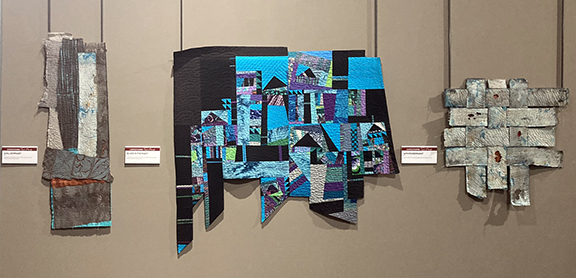
Detroit fabric artist Carole Harris’s work, including the three at the top of this post, comprised an exhibit called Time Pieces. The quilts are (from left) Wall Remnant, Blues in the Night, and Woven Remnant. She explains on her website that her work “relies on improvisation. I am fascinated by the rhythms and energy created when I combine multiple patterns and textures. I let the material and colors lead me on a rhythmic journey.” I believe this exhibit closed in November, but you can see some of her art on her website.
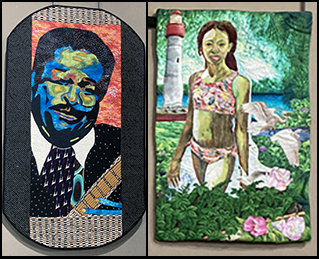
The mother-and-daughter team of the Black Renaissance exhibit are Lola Jenkins, mother, and Precious Caroll, daughter. Their creations, remaining through early March 2024, include a lot of small quilt portraits of famous and ordinary people. Lola Jenkins’ colorful portrait of BB King and Precious Caroll’s young girl in, “Lighthouse by the Tree,” are just two examples of their work. Most of their quilts are roughly the size of a small painting and I can imagine them mounted on a wall behind a couch or in a bedroom.
Jenkins, on the quilt museum website, says, “Using fabric as paint helps me to understand and express my feelings and … helps to make me feel whole.” Carroll, also on the website, explains she moved from Delaware to Nebraska “with the primary focus to learn my mother’s quilting techniques… .”
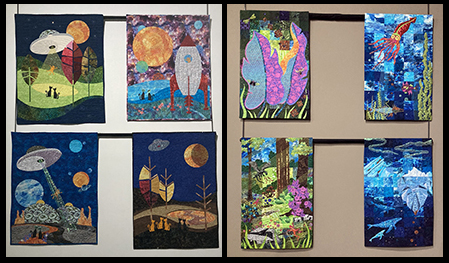
Reese created the left four quilts; Brueggenjohann, the right.
The other team — wife Jean Brueggenjohann and husband James Reese — also create smaller pieces, but draw their inspiration from natural and imagined worlds. Brueggenjohann uses traditional quilt piecing techniques to lead viewers through stories. Reese previously worked with metals or in digital media, seels his fabric images and playful mixes of color, pattern and design to create stories. Their show called Divergent Paths — Altered Realism & Abstraction will also be featured at the museum through early March.
The images of Reese’s four-part story, clearly science fiction in nature, are called (from far left, top to bottom) “They’re Back!,” “Where No Cat Has Gone,” “They’re Here,” and “They Don’t Stop Anymore.” These quilts are all from 2023.
Brueggenjohann makes scenes from nature in her 2022-23 quilts “The OtherWorld” (from mid left, top to bottom), “The Garden,” “The Sea,” “The Forest” and “The Polar Night.”
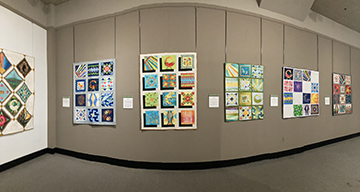
One of the smaller galleries included quilts that are part of the museum’s “Block of the Month Club.” Quilts from Round 4 of the challenge, in my “panoramic” shot illustrate the interpretations quilters gave to the theme. They were scheduled for exhibit through early December. And there were lots of blues.
The theme for Round 5 is Exploration/Exploring/Explore. Seeing these quilts made me wish I knew how to sew. But I started thinking about ways I might be able to mimic the look in the needlecraft I know–crochet. We’ll see. But for folks with actual quilting skills, check out the challenge on the museum website.
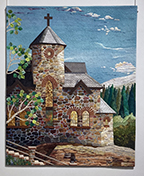
Another blue that caught my eye was Annette Kennedy’s “Mountain Chapel” from 2008. It was one of the more traditional in appearance, but I guess the Longmont, Colorado, resident might have been influenced by views near her home.
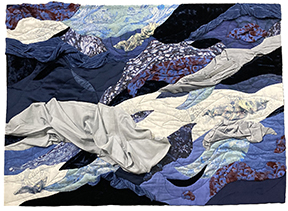
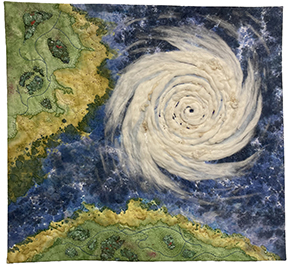
But the exhibit that I found most fascinating on this trip was the exhibit from Studio Art Quilt Associates titled “Primal Forces: Wind” that will remain through Jan. 9, 2024. Not only was it full of blues, it also featured a huge variety of fabrics, quilting styles and interpretations of wind.
Dorothy Raymond of Loveland, Colorado, created the free motion, appliqued quilt she called “Turbulence” (left) in 2022. Signs in the museum remind visitors not to touch the quilts, but I had a hard time keeping my hands off the silks, cottons, wools and other fabrics of “Turbulence.” The quilt created for me a sense of waves rippling wildly across the surface of an ocean, and I wanted to dip my hands right into the “water.”
Victoria Qutierrez of Reno, Nevada, created “Winds of Change” (right) in 2022. Can’t you just see the hurricane approaching the sandy beaches and forested shores of two islands? That’s what I see in the cotton, rope, wool roving, Angelina fiber and glass beads in this quilt. It is so much more vivid than any of the weather maps that illustrate these massive storms.
As a Midwesterner, I couldn’t help being sucked into Cat Larrea’s “Tornado” (left) from 2022. The hand-dyed cotton quilt with fused applique makes me want to head to the basement. I was surprised to learn that Larrea is from Anchorage, Alaska.
There were so many beautiful images in this exhibit I could find dozens more to share, but enough is enough. If you happen to be passing Paducah on any road trips in the next few weeks, I encourage you to follow the signs to the National Quilt Museum and see them for yourself.
In fact, I urge you to do as I’ve done: Make it a regular stop in your travels. There will always be something new to see.
Last October, my friend Marsha and I decided we were going to make a virtual trip along the Mississippi River. Virtual because we were inspired by a walking program that pops up on social media from time to time. It gives real medals (and inspiration along the way) to people who walk or bike the same distance as famous paths — El Camino Santiago or the Appalachian Trail — without having to travel to the actual location.
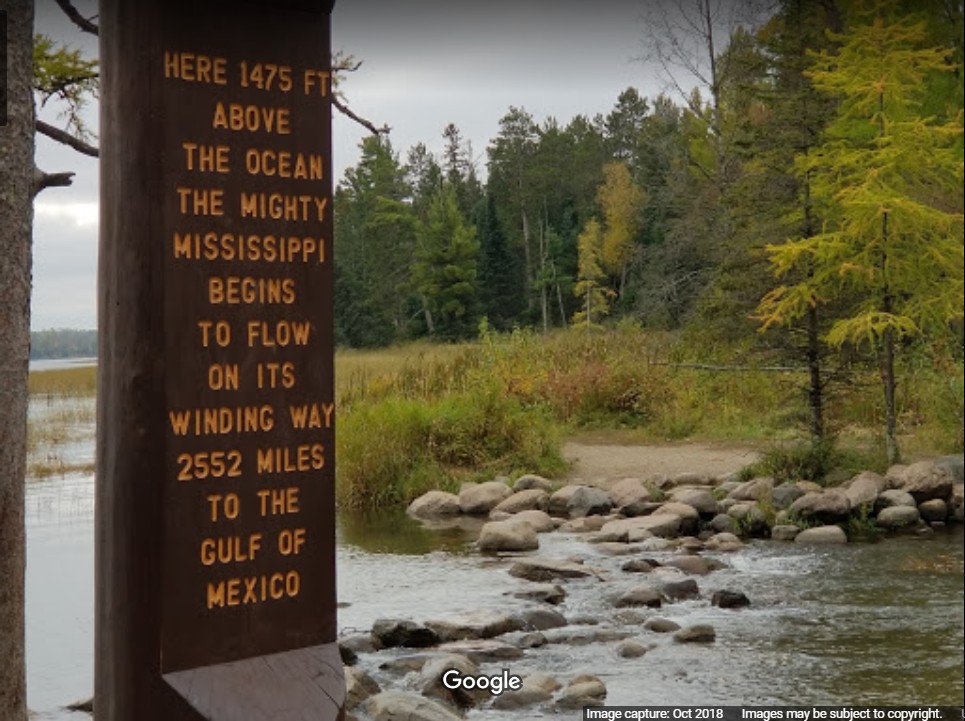
We both wanted to get more exercise and it seemed like a fun idea. Walking the Mississippi appealed to us, in part, because we grew up within its watershed, both of us close enough to get to it in an hour or two by car. She was going to walk up from the Mississippi Delta area in Louisiana, and I was going to walk down from the source of the river (a place I actually visited once way last century) in Minnesota. And so, we started.
Neither of us did a great job keeping track of our progress initially. I got a pedometer, but was never sure how to translate my steps into miles. And my old exercise bike didn’t have any bells or whistles. I could have kept track of how long I was on the bike, but there was no way to turn that information into miles..
The old bike broke and I got a new one with a measurement labeled ODO. I didn’t have to read the instructions to get on and pedal, so I just ignored that measure and tried to remember to record the mileage when I spent time on the bike. This week, though, I had a sudden realization that ODO might be short for odometer. So, I looked it up. Lo and behold, the bike has been keep tracking of my mileage for me.
Now, I’m not a daily biker. And I don’t get on the bike for more than 20 or 30 minutes at a time. Sometimes just 15 minutes between commercials if I’m watching TV. But I have a record since I got the new bike late last December. Hmm, I thought. I could do some math and extrapolate an average since last October, but that’s actual mental work. So I figured I’d just go with what I know and count it toward my journey down the river.
I also popped for a new smart watch that translates the steps I take each day into miles. Yay! More math I don’t have to do. Yes, I still had to add the daily figures. And I tried to convert my steps over the past year into mileage amounts. And any biking I did before I got my new bike at Christmas are a complete wash. But …
(Time out to do the math)
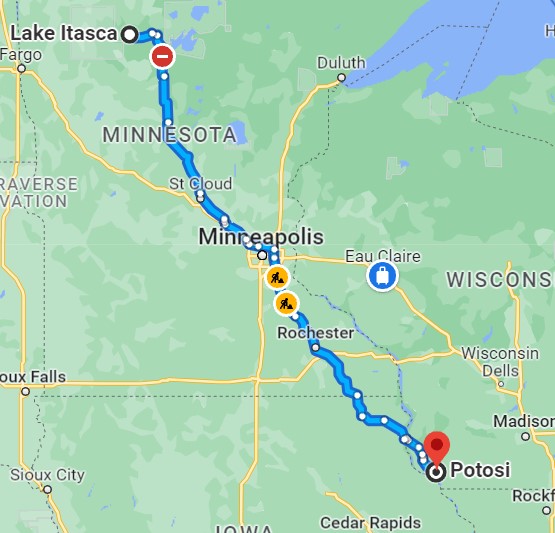
(Thank you, Google Maps)
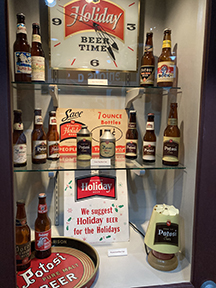
By my calculations and estimates, I’ve put in 455 miles since we started our challenge last October. And that’s roughly the equivalent of going from Lake Itasca, where the Father of Waters starts in Minnesota, all the way to Potosi, Wisconsin! Home of the National Brewery Museum and two of my friends from high school. We spent some time together there this June. But that’s another post.
(Sharon’s pic)
It also means I’ve made it to about 85 miles from home, which is way farther along than I expected to be when I got the notion to figure out how far I’ve “traveled” in the past year.
Now all this math only serves to reveal that I’m still way too sedentary, but somehow, now that I have real data, the challenge is feeling less theoretical and more empirical. And, remarkably, it also feels possible! I think I’ll try to pick up the pace a little now.
As for medals, we aren’t going to have any cast for us when we meet in the middle. But maybe Marsha and I will find a way to have an actual dinner together somewhere along the river. I’ll bring the Potosi beer.







 sharon p. lynn