And we’re off…

(Pexels photo by Andrea Piacquadio)

When my friend Mary and I headed north for the Wisconsin Writer’s Association conference in Stevens Point on Oct. 2, little did I know that I would cross one of the first hurdles in any writer’s life. A hurdle that would make me want to be glued to my keyboard for the rest of the month. But various life events and previous commitments turned into the second hurdle between me and the end of this particular race.

So, about that first hurdle. Writers who want to try to be traditionally published must first find an agent. I figured I’d try one of the practice pitches offered early in the conference, and, what the heck, I signed up for a real pitch, too. That was on the last day of the conference and I figured it would be good practice, too. I’d have a chance to talk to an agent about what she was looking for, how I could improve my pitch, what I should plan for next time.

But as I paused in my initial statement — my mostly bungled log line and a bit about the plot and main characters — she grabbed a sheet of paper and said, “Here’s what you do next.” She actually asked to see my first fifty pages! I was astonished. (And to save us both embarrassment in case I trip over the next hurdle, I’ll keep her anonymous.)

But, after accepting congratulations from Mary and other friends at the conference, I got home and started polishing those pages. I’m still polishing with just a few days left to send them to the agent.

They were rougher than I remembered. And all in first person.

I made the decision months ago but didn’t act on it because I was busy with some short stories that had more immediate deadlines. So, on Oct. 6, I started changing the point of view from first to a version of third person, variously called “limited” or “close” third person.

I’ve had to fight two tendencies as I’ve revised. One battle is to keep away from the omniscience that is, frankly, a natural POV for me. I’m making it up, after all, so of course I know everything. The other is to let the reader into the head of my POV characters. In other words, I have to convince myself it’s okay to read my character’s minds and share all that with my readers.

Another problem was a decision to add the second POV, and that meant moving a discussion from a later chapter up closer to the front. Based on what my wonderful critique partners have said–independently, I might add–that seems to be my roughest chapter.

I should be working on that, not this, right now. I only have a few more days to get it done.

But in all the years I’ve been writing this blog, this is one of the key moments in my fiction career. And it may go no further if the agent who decided to take a chance on fifty pages decides they’re too rough for her to take any on. (Fingers crossed she likes them.)

Still, an agent let me cross the first hurdle and I’m still aglow with joy and hope. This is my celebration. (I’ll break out some wine after I send the pages.)

À bientôt!

5 tips for finishing your writing project

My local writing group just held its first Writing Day Camp for Big Kids (high school age and older). My contribution was this list of tips to help finish.

1. Pick your project

Pexels, Suzy Hazelwood

What sort of project do you want to try? Aiming for a well-written family Christmas card is a much different goal that trying to write a full novel. Knowing what your goal is will help you figure out how much time you’ll need to plan for the project.

If you’re just getting started with writing, it may help to begin with smaller projects so you can learn how nice it feels–and how long it really takes–to finish something.

2. Get started

There is no right way to start your project. We’ve shown you how to start from a prompt today. You can also start from scratch, a process many call pantsing – writing by the seat of your pants. Or you can plot. If you like the idea of plotting, there are all sorts of free resources on the web, including:

https://www.cultofpedagogy.com/narrative-writing/ (This is for teachers to guide students, but it has all the main steps for planning a story.)

https://jerichowriters.com/how-to-plot-a-novel/  (standard plotting)

https://jerichowriters.com/how-to-plot/ (“snowflake” plotting

Sites like these will often ask you to sign up for newsletters or buy classes or services. Feel free to ignore the requests. You can look at these without buying anything.

A book may be bigger than what you want to do, but the steps and advice can be pared down to smaller projects.

3. Schedule time to write

Pexels, Jess Bailey Designs

Put writing time in your calendar. One of the biggest problems we Gals have faced is working writing into our lives. And while you often hear the advice that your must write every day, it’s more important to keep to a schedule even if it’s less frequent. I know a couple of novelists who have completed books with the bulk of their writing time coming on weekends.

Seriously, if you keep a calendar, put your writing time on it. In BIG HIGHLIGHTED LETTERS if that helps.

If you miss a writing appointment, don’t quit. Just pick up at your next scheduled date. It’s all about building a habit.

4. Read

Read often and widely. Stephen King says he writes every morning and reads every afternoon. It helps to read the kinds of articles, essays or books you want to write. But it also helps to read well-written books of any type. Fiction or nonfiction, literary or genre. I’ve always believed the rules of writing seeped into my mind as I read books, magazines and newspapers as a child. I was good at writing in school not because I could diagram sentences well – I hated doing that—or because I remember all the rules of grammar. I still think I learn every time I read someone else’s work.

To keep your reading on track, there are books clubs in the area. I belong to a couple online and a couple at the Freeport Public Library. Check your nearest library to see if they have one.

5. Find your writing group

Pexels, Elevate

There are any number of regional, national, and international organizations for writers. They revolve around topics, genres and geographic areas. Some meet online, some in person. Membership costs vary. Here are a few to consider:

Chicago Writers Association — https://www.chicagowrites.org/join

Northern Illinois Newspaper Association — https://ninaonlinedotorg.wordpress.com/membership-2/

National Federal of Press Women — https://www.nfpw.org/join-nfpw

Illinois Women’s Press Association — https://www.iwpa.org/membership/join-us/

Wisconsin Writers Association — https://wiwrite.org/about-wwa-2/join

Off Campus Writers’ Workshop — https://ocww.info/join-ocww

Sisters in Crime — https://www.sistersincrime.org/page/join-now (There are Chicagoland and Wisconsin chapters of this group, as well as the totally online Guppy chapter.)

Women Fiction Writers Association — https://wfwa.memberclicks.net/index.php?option=com_mcform&view=ngforms&id=38580#/

Academy of American Poets — https://poets.org/membership

Haiku Society of America — https://www.hsa-haiku.org/join.htm

Society of Children’s Book Writers and Illustrators — https://www.scbwi.org/membership

Creative Academy for Writers — https://creativeacademyforwriters.com/join-us/ (This group is headquartered in Vancouver, BC, Canada. You can join and take part in many activities for free.)

Historical Novel Society — https://historicalnovelsociety.org/members/why-join-the-society/ (Founded in the UK, it also has a US headquarters.)

American Christian Fiction Writers — https://acfw.com/acfw-membership/

National Association of Memoir Writers — https://www.namw.org/become-a-member/

Speculative Literature Foundation — https://speculativeliterature.org/membership/ (For information about the Chicago chapter, drop a note to lewella@speculativeliterature.org.)

Happy writing, everyone.

À bientôt!

Wisconsin writers’ tour

In one whirlwind day this month, I attended a writers’ conference and met “Agatha Christie” in southeast Wisconsin.

When I heard about an Agatha Christie “evening” as a fundraiser for the Wisconsin Historical Society, I wrongly assumed it would be at the Historical Society Library on the UW campus in Madison. But when I figured out she would be performing in Lake Geneva, I bought a ticket anyway. The drive would be a little more than an hour from my house, not the forty-five minutes to Madison, but not a stretch.

A few weeks later, friends told me they were taking part in Book Fest in Janesville, Wisconsin, a faitly new summer event sponsored by the Hedberg Public Library. And it was free! Scheduled the same day as Agatha’s visit, I RSVP’ed for two of the Book Fest events. It was also about forty-five minutes from my house. (Lake Geneva would be about thirty minutes from there.) It was going to be a scorcher, so I was looking forward to a day out of the sun.

Happily, the drive over was a bit quicker than I though and I arrived in time to sneak into the end of a session I hadn’t signed up for. That was “Everything You Need to Get Started” with Ken Brodsy in the Fireplace room. The gatherine was in an almost living room-like meeting place at one end of the main library room. He had some great tips, even at the end, and a plotting handout I was happy to take home.

I’d signed up for “Bringing Your Manuscript to Port: Navigating the Varied Channels to Book Publication.” Two of my Wisconsin Sisters in Crime–Christine DeSmet and Peggy Joque Williams, were on the panel, but so was Kristin Oakley, a friend from a now-defunct writing group in Rockford. She’d moved to Madison and I hadn’t seen her in years.

The moderator and fourth panelist, Ken Humphrey, is also the man behind the Wisconsin Writers Association email, hello@wiwrite.org. (I love the domain name. After all, the only answer to “wiwrite” is why not?) Ken and I had been exchanging email about the WWA fall conference and my membership listing. He has resolved everything with aplomb.

Each of the four panelists followed different routes to publishing from traditional to hybrid to independent (self-), and they shared boons and banes of each path. They also had some great handouts.

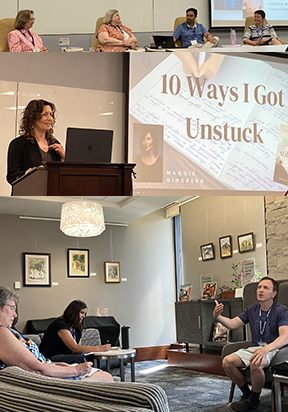
I ordered the optional delivered lunch but got so busy chatting with the other woman at my table, and the morning snacks had been so good, that I barely ate it. She and I stayed put for the master class with Maggie Ginsberg, Madison author of Still True, which won the 2023 WLA Literary Award for Fiction and received an honorable mention for the 2022 Edna Gerber Fiction Book Award. Her talk on “10 Ways I Got Unstuck” was full of great tips for writers in any literary genre. And, of course, there was a handout. (Do you sense a pattern in my enthusiasm?)

I think my favorite was her reminder that it’s not fair to compare a work-in-progress to another author’s finished, published work. It’s messy before those final edits, no matter who you are.

After Ginsberg’s talk, authors lined the halls at tables piled with their books and swag, and library patrons had a chance to mingle, chat, buy books and get autographs. Kudos to Janesville’s Hedeberg Public Library for putting on such a great event for four years. Hope they can keep it up.

But, by now I was hungry, so I went downstairs to The Ground Floor, the Friends of the Library’s coffee and book resale shop. I bought some tea and finally had a chance to eat my lunch before heading toward Lake Geneva.

I detoured through Delavan, another cute southeast Wisconsin town, before following my GPS to a small country school that felt like it was in the middle of nowhere. As far as I could tell, I was nowhere near downtown Lake Geneva. The school was surrounded by fields, with nary a house in view.

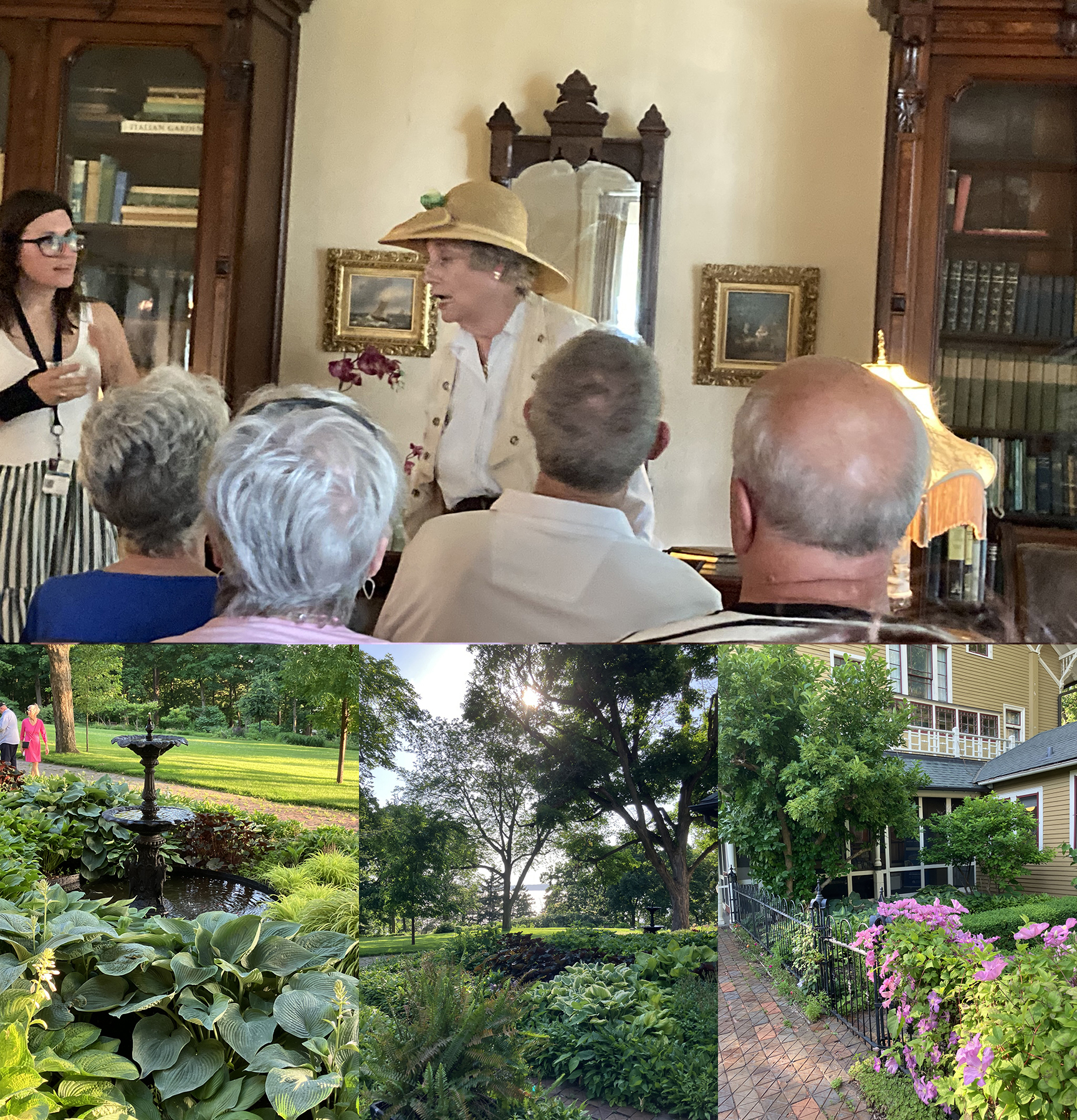
(Photos by Sharon)

The part I hadn’t noticed in my email with the ticket was that the school was a staging area for a shuttle to the actual performance location. Agatha was visiting Black Point Estate and Gardens on Lake Geneva, not someplace in Lake Geneva.

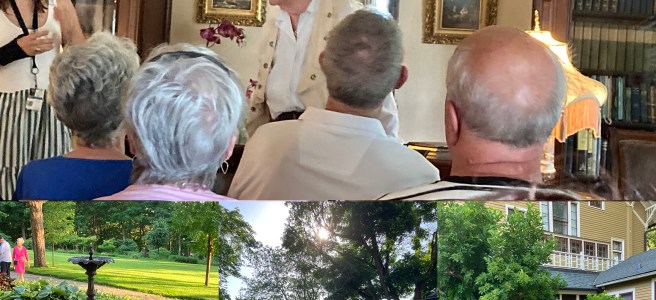
There were few enough at the talk that we caravanned through winding, shaded country roads to the estate. We had wine on the porch facing the lake before moving into the un-air conditioned 1888 home built for a Chicago “beer baron.” At that time, the rail service could get him from his summer retreat in Wisconsin to Chicago in about an hour.

The fence and gardens near the house reminded me of Monet’s Giverney in France, but the family wasn’t as interested in backdrops for painting as they were in fun at the lake. From the lawn near the house, you could see the sparkling water between trees at the bottom of the rolling lawn. Visiting during regula hours might be worth a trip back to the estate someday.

But I, and a couple dozen other folks, had come to meet Agatha. Local historian and actress Chris Brookes brought a circa 1950 Agatha to the event, sharing elements of her life and writing to that date. She’ll be doing another presentation Sept. 20 at Black Point, in case you’d like to hear her. It was fun. She read from a couple of her books, occasionally strolled back into the audience, and asked them questions.

After the performance, we could wander around the first floor and gardens. It made for a lovely evening, and I managed the drive home before sunset despite dawdling along the way. I even stopped in Sharon, Wisconsin, for a selfie. (I was tempted to bring a bucket of soapy water back to town, but I haven’t done it yet.)

Day trips can be lots of fun, can’t they?

À bientôt!

May needs to slow down

May is departing in haste this year. At least from my perspective.

I started the month by ending my trek from Malice Domestic in Bethestda, Maryland, to Alabama to visit my son and his family. The trip was generally uneventful, but I’m not a long-distance driver. Oh, I drive long distances, but I break up the trip over multiple days. Fortunately, the weather was generally good for all my spring travels.

I stuck around a week, had lots of fun with kids and grands, and got a Mother’s Day gift a week early when my son took me to Atlanta to see a wonderful production of Wagner’s opera, Siegfried. For those who don’t know the opera, think dark fairy tale with an evil, troll-like blacksmith; a youngish lad destined to become a great warrior who wields the sword of power; a wizard akin to Sauron who ruled Mordor in The Lord of the Rings; the wizard’s wife who is effectively a prisoner of the tower wating for the Fates to release her; and a female warrior who has fallen in battle and who needs her prince (hark back to the young warrior) to come and awaken her so they can fall in love. A perfect story for a kid who grew up watching “He-Man and the Masters of the Universe” cartoons on TV.

(Screenshot of IMDb site)

In this production, the sets varied from dark views of what could be the interior of the Death Star in Star Wars complete with heavy steam punk overtones to mountaintop fantasies that only lacked dragons threating, and hosts of fairies circling, the lovers. I enjoyed every minute of the four-hour opera, even when I got caught up in the music and forgot to read the translations of the German. (My German was never good enough to get me through an opera, but I’m afraid it’s so rusty now I hardly picked up a single word.)

Ok, so that was just part of great week with my farflung family.

I’d been putting off so much during the three weeks I was away that I should have jumped in as soon as I go home to try to catch-up but I just vegged the whole weekend and didn’t plunge into my third short story draft for until Monday. Got that done and off to the critique group, then read the newest versions of the other writers’ tales with twists. Right before I dug into 140 pages of another friend’s cozy novel draft. I had critique meetings online for both sets of pages in Thursday.

But in the meantime, I also received the first 120-or-so pages of awards and judges’ commentary for a journalism organization I’m still part of. I have volunteered to proof the monthly newspaper, and the June issue is always devoted to the awards presented at the annual conference. Got those read by Friday, just in time to make my 10 a.m. dentist appointment.

(Sharon’s photo illustration)

The Saturday after I got home, I went up to Madison with my sister and women’s group from an area church. We strolled around the capitol square for the weekly farmer’s market. In addition to some amazing looking vegetables, garden plants, cheeses, and so much more, we got to listen to various protests groups (respectfully placed across the street from the market), and some musicians, including Cover Fire from the 132nd Army Band and the Raging Grannies. After a great early lunch at Barrique’s downtown, we popped into Grace Episcopal Church on the Capitol Square for a free noon concert by the local Ancora String Quartet. And finally, before we headed to the Overture Centure for a performance of Clue, a genuinely funny new comedy, we strolled down the block of crafters and I finally found a UW Wisconsin Terrace Chair to go with my Bucky Badger bobblehead.

(Background petunias by Valeska Huyskens on pexels.com; foreground images by Sharon)

The next week, I finished proofreading the last 287 pages of contest winners (see last week), and on successive days, I made it to my local writing group, my League of Women Voters International Studies discussion, my Shakespeare Society meeting, Temple Beth El’s annual Food O Rama fundraiser (to buy hot dogs, pickles, challah bread and blintzes–yum!), lunch with a writing buddy, and the next day with my daughter and friends, followed by book club. And that week ended with a Saturday drive to Dixon, Illinois, the petunia capiltal of the state and host of the annual Petunia Festival. (Mark your calendar for July 3-6.) I joined a few writing friends and we spent three hours at the library working on writing projects. (Yes! I got a new short story started!) We also looked at their Abraham Lincoln and Ronald Reagan displays, the gorgeous 1899 building. While it resembles some Carnegie libraries, that is probably due to the architectural styles of the day, but Dixon’s benefactor was local resident, O.B. Dodge. His picture hangs above a fireplace on the main floor. We really loved the display of “hidden” book covers showing the first lines of several books. As readers, we thought it was a great way to lure folks to the books. As writers, we were reminded of how important those opening words really are.

(Sharon’s photo)

Sunday, I shopped for our family cookout on Monday, which turned out to be a beautiful, sunny day.. Tuesday, I had an oil change and today I have more errands to run.

But, for those who have yet to celebrate Memorial Day, remember it was originally marked on May 30. So you still have a bit of time.

As for me, I am ready to flip the page to June. And keep working on that new short story.

À bientôt!

Short stories are fun

(Pexels photo by Ron Lach)

But that doesn’t mean they’re easy.

Some writers I know have said short stories are much harder than novels because you have to make every word count.

I just happen to have a long-standing love of the short story that started when I discovered science fiction magazines when I was in high school. That’s when I wrote my first short stories, all centering around sci-fi topics.

When my kids were little, I read mostly magazine short stories for the same reason I had a subscription to Reader’s Digest. I could devote a few minutes to reading after the kids went to bed or between tasks. I could get a beginning, middle and end in one sitting, something impossible with a novel.

When I discovered audio books that I could listen to on my commute, I did get back into novels and longer non-fiction, which pushed short stories into the background of my reading and writing. But in the past couple of years, I’ve rediscovered the format and jumped back in.

I’ve submitted short stories to a few anthologies, and won a spot in the Guppy anthology, Gone Fishin’: Crime Takes a Holiday. For those, I wrote stories, and sent them into the virtual slush pile for editors to evaluate without knowing who I am. For this story, third time was a charm, and I got to work with editor Jim Jackson of Wolf’s Echo Press, who really helped me improve the final version of “Blood on the White Rose.”

I’d already run several iterations of the story through my critique partners. Four in particular kept telling me the story on the page wasn’t the story I kept saying it was. Finally, days before the submission deadline, they got through to me. At least they spurred me on to rewrite the entire story, bringing forth a more fleshed out main character, and cutting the duration of the events. In its first version, the story took place over a period of weeks. In the end, it lasted something under 24 hours.

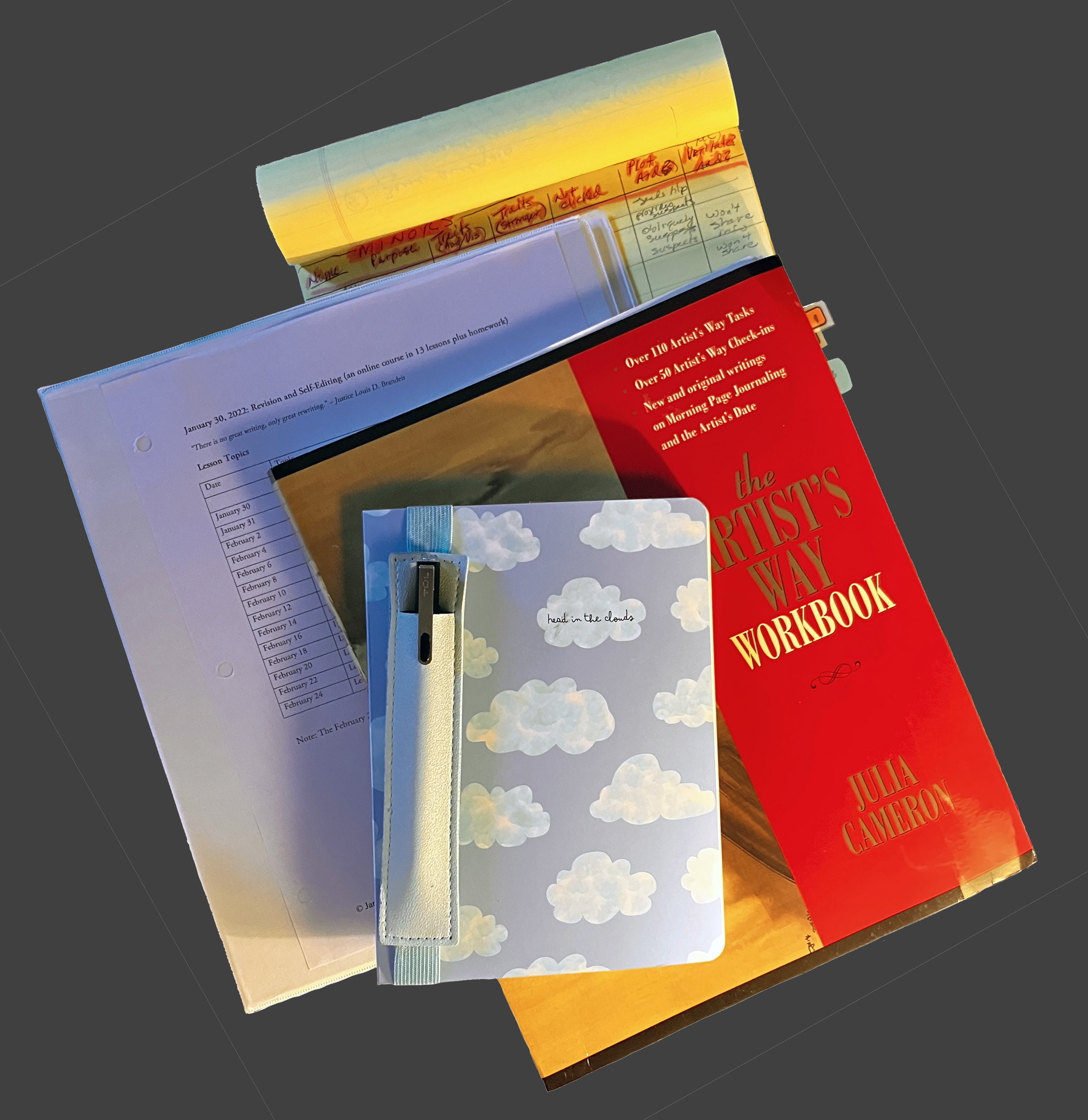
What really intrigues me about the OCWW process, though, is the attention to the story before it ever sees an editor. I was assigned to a critique group, given a deadline of March 20 to submit a draft, and received copies of my critique partners’ stories to review before our first critique meeting on April 1.

Of course, I had more than one short story I thought might fit the anthology theme: I didn’t see that coming. I sent two and asked the group to help me select one for my final focus. We’ll see what they say, because I will need to make a first round of revisions before our next meeting, April 17.

But we have until late June to work with each other before our next submission deadline. At that point, we’ll go into a developmental editing process. I have never done anything explicitly called developmental editing, although I may find that’s exactly what I went through with Jim.

I have always imagined developmental editing is something that takes place while the story or novel is in the draft stages with the author. I’m looking forward to being more enlightened as we head toward a 2026 publication of the OCWW anthology. I’ll keep you posted.

À bientôt!