And the changes are sticking

Sharon P. Lynn’s photo

I wandered through January making small “resolutions” as I thought of them. Having got most of my calendars figured out–I’m pretty sure the pocket sized one will get bigger for next year–I started some new projects. About three quarters of the way through January, I decided to get serious about jumping on my treadmill more often. I even bought some colored stars (I guess those gold stars in school really impressed me.), and I have a star on six out of seven days through February. Moving a bit every day is a good plan for me.

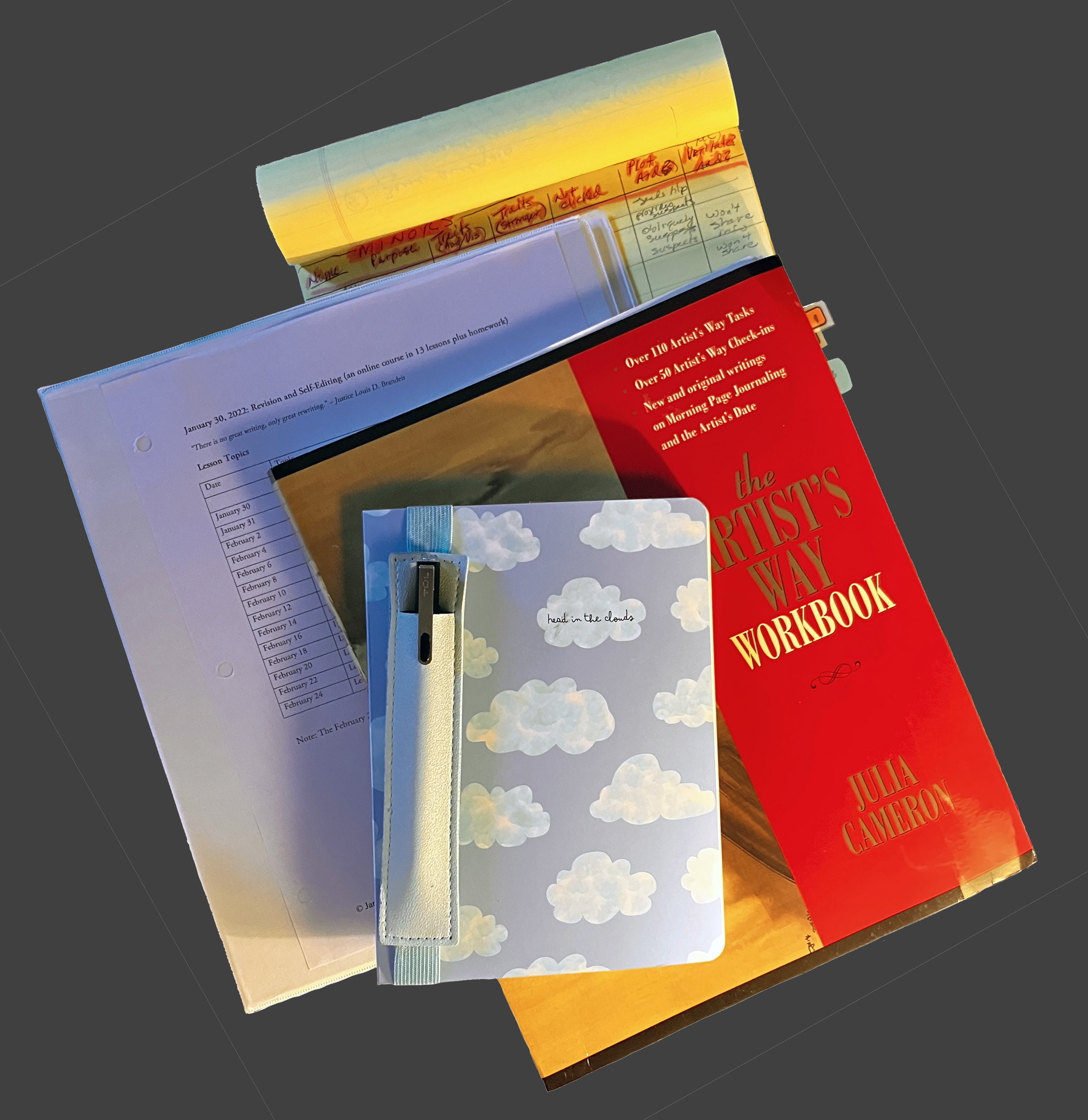
I also found The Artists Way workbook that I bought a couple years ago and let sit on an end table in the TV room. I started reading, and I’ve been doing morning pages for a full month! I remember hearing about them years ago from friends who swore by them. But I didn’t really understand the way they are supposed to work until I read the explanation in the workbook. I love the way they help me unload the mind-mess I wake up with. I’ve taken to ending them with a couple–just a couple–of things I want to accomplish that day or the next. I really believe writing one or two daily goals made me more productive. I certainly feel more productive this month.

I will say some of the thinking of Julia Cameron, the author of what I’ve taken to abbreviating TAW, was initially off-putting to me. She speaks in a language of recovering: recovering a sense of safety, of identity, of power, and so on. To me recovering implies a loss, or a sickness of heart. But when I substituted discovery for recovering, the book felt much homier and welcoming to me. I think I’m discovering more of the artist inside that I’ve always know was there, but that I didn’t give time to because I was busy working and trying to be a good mom to my kids. Now that I’ve retired, I feel like discovering the potential I’ve left dormant for decades.

I haven’t done as well on the solo artist’s dates as I might. That’s partly because my schedule is already so full. I have writing groups six days a week, three book clubs every month, plus a couple of study groups, the League of Women Voters, and a social gathering or two. And I feel that many of those events feed the artist in me without going it alone. I’ll try to fit in some of the prescribed dates, but I’m not too worried about that.

And the other thing I started doing was working through a revision course I took four years ago through the Sisters in Crime Guppy chapter. Our former president Jim Jackson taught the course. (He teaches three and I’ve taken them all.) I used the same novel I’m working on now for the course, but I knew I wouldn’t be able to focus a lot of attention on it because my “big volunteer job” started about half way through the course.

I kept every note, though, and I printed them out at the end of January and started with the first step–rereading the entire draft. This time, I learned so much more than last time! With nothing competing for my time and attention, I was able–finally–to discover that I won National Novel Writing Month (NaNoWriMo) with the first draft because, as a pantser, I just wrote words as they came to me. The point of NaNo was to get 50,000 new words in the 30 days of November. I did that the year I drafted this novel, but only because I wrote whatever came to mind at any given writing session.

Reading through this time, I realized how much is way out of order, how much is backstory and info dumps that don’t need to be in the story, and where the big and small plot holes are. I also made a list of all the scenes in the book. I got into the early triple-letters (AAA, BBB, etc.). I’m working on my list of minor characters as I close out February. Because I wrote them as I thought of them, in previous revision attempts I fixed some minor problems without fixing the big ones. As soon as I finish the “character census,” I’ll make a new scene chart and put the scenes in the right order and start by fixing the plot problems

I can’t believe how much fun I’m having finding the problems in the story. And knowing I’m building a strong plan for my revision.

I’m not so foolish as to believe I’ll be creating a “perfect” draft this time around, but I think it will be good enough–with help from my critique partners–to try to shop it to an agent again. I really wasn’t ready for the pitch in October, but I wanted to give it a try. She, rightly, declined it. But the pitch was great for practice and I know the general outline of the plot and characters are good, or she wouldn’t have told me to send her pages. One of the big changes that will come in this draft is losing a good chunk of the very beginning of the story. Maybe I’ll have good luck next time, too.

A bientôt!

And we’re off…

(Pexels photo by Andrea Piacquadio)

When my friend Mary and I headed north for the Wisconsin Writer’s Association conference in Stevens Point on Oct. 2, little did I know that I would cross one of the first hurdles in any writer’s life. A hurdle that would make me want to be glued to my keyboard for the rest of the month. But various life events and previous commitments turned into the second hurdle between me and the end of this particular race.

So, about that first hurdle. Writers who want to try to be traditionally published must first find an agent. I figured I’d try one of the practice pitches offered early in the conference, and, what the heck, I signed up for a real pitch, too. That was on the last day of the conference and I figured it would be good practice, too. I’d have a chance to talk to an agent about what she was looking for, how I could improve my pitch, what I should plan for next time.

But as I paused in my initial statement — my mostly bungled log line and a bit about the plot and main characters — she grabbed a sheet of paper and said, “Here’s what you do next.” She actually asked to see my first fifty pages! I was astonished. (And to save us both embarrassment in case I trip over the next hurdle, I’ll keep her anonymous.)

But, after accepting congratulations from Mary and other friends at the conference, I got home and started polishing those pages. I’m still polishing with just a few days left to send them to the agent.

They were rougher than I remembered. And all in first person.

I made the decision months ago but didn’t act on it because I was busy with some short stories that had more immediate deadlines. So, on Oct. 6, I started changing the point of view from first to a version of third person, variously called “limited” or “close” third person.

I’ve had to fight two tendencies as I’ve revised. One battle is to keep away from the omniscience that is, frankly, a natural POV for me. I’m making it up, after all, so of course I know everything. The other is to let the reader into the head of my POV characters. In other words, I have to convince myself it’s okay to read my character’s minds and share all that with my readers.

Another problem was a decision to add the second POV, and that meant moving a discussion from a later chapter up closer to the front. Based on what my wonderful critique partners have said–independently, I might add–that seems to be my roughest chapter.

I should be working on that, not this, right now. I only have a few more days to get it done.

But in all the years I’ve been writing this blog, this is one of the key moments in my fiction career. And it may go no further if the agent who decided to take a chance on fifty pages decides they’re too rough for her to take any on. (Fingers crossed she likes them.)

Still, an agent let me cross the first hurdle and I’m still aglow with joy and hope. This is my celebration. (I’ll break out some wine after I send the pages.)

À bientôt!

May needs to slow down

May is departing in haste this year. At least from my perspective.

I started the month by ending my trek from Malice Domestic in Bethestda, Maryland, to Alabama to visit my son and his family. The trip was generally uneventful, but I’m not a long-distance driver. Oh, I drive long distances, but I break up the trip over multiple days. Fortunately, the weather was generally good for all my spring travels.

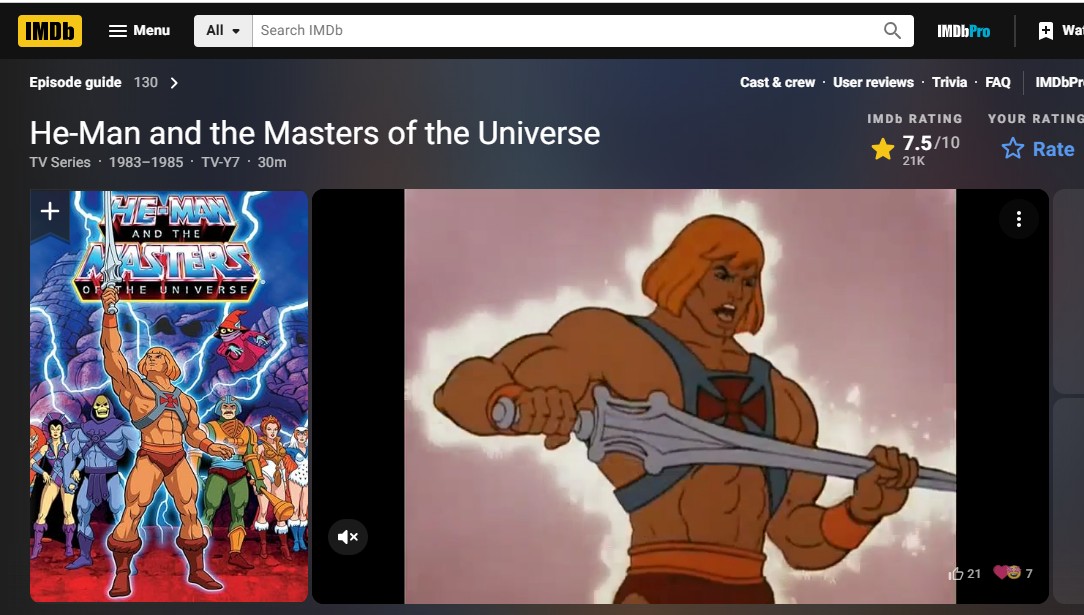
I stuck around a week, had lots of fun with kids and grands, and got a Mother’s Day gift a week early when my son took me to Atlanta to see a wonderful production of Wagner’s opera, Siegfried. For those who don’t know the opera, think dark fairy tale with an evil, troll-like blacksmith; a youngish lad destined to become a great warrior who wields the sword of power; a wizard akin to Sauron who ruled Mordor in The Lord of the Rings; the wizard’s wife who is effectively a prisoner of the tower wating for the Fates to release her; and a female warrior who has fallen in battle and who needs her prince (hark back to the young warrior) to come and awaken her so they can fall in love. A perfect story for a kid who grew up watching “He-Man and the Masters of the Universe” cartoons on TV.

(Screenshot of IMDb site)

In this production, the sets varied from dark views of what could be the interior of the Death Star in Star Wars complete with heavy steam punk overtones to mountaintop fantasies that only lacked dragons threating, and hosts of fairies circling, the lovers. I enjoyed every minute of the four-hour opera, even when I got caught up in the music and forgot to read the translations of the German. (My German was never good enough to get me through an opera, but I’m afraid it’s so rusty now I hardly picked up a single word.)

Ok, so that was just part of great week with my farflung family.

I’d been putting off so much during the three weeks I was away that I should have jumped in as soon as I go home to try to catch-up but I just vegged the whole weekend and didn’t plunge into my third short story draft for until Monday. Got that done and off to the critique group, then read the newest versions of the other writers’ tales with twists. Right before I dug into 140 pages of another friend’s cozy novel draft. I had critique meetings online for both sets of pages in Thursday.

But in the meantime, I also received the first 120-or-so pages of awards and judges’ commentary for a journalism organization I’m still part of. I have volunteered to proof the monthly newspaper, and the June issue is always devoted to the awards presented at the annual conference. Got those read by Friday, just in time to make my 10 a.m. dentist appointment.

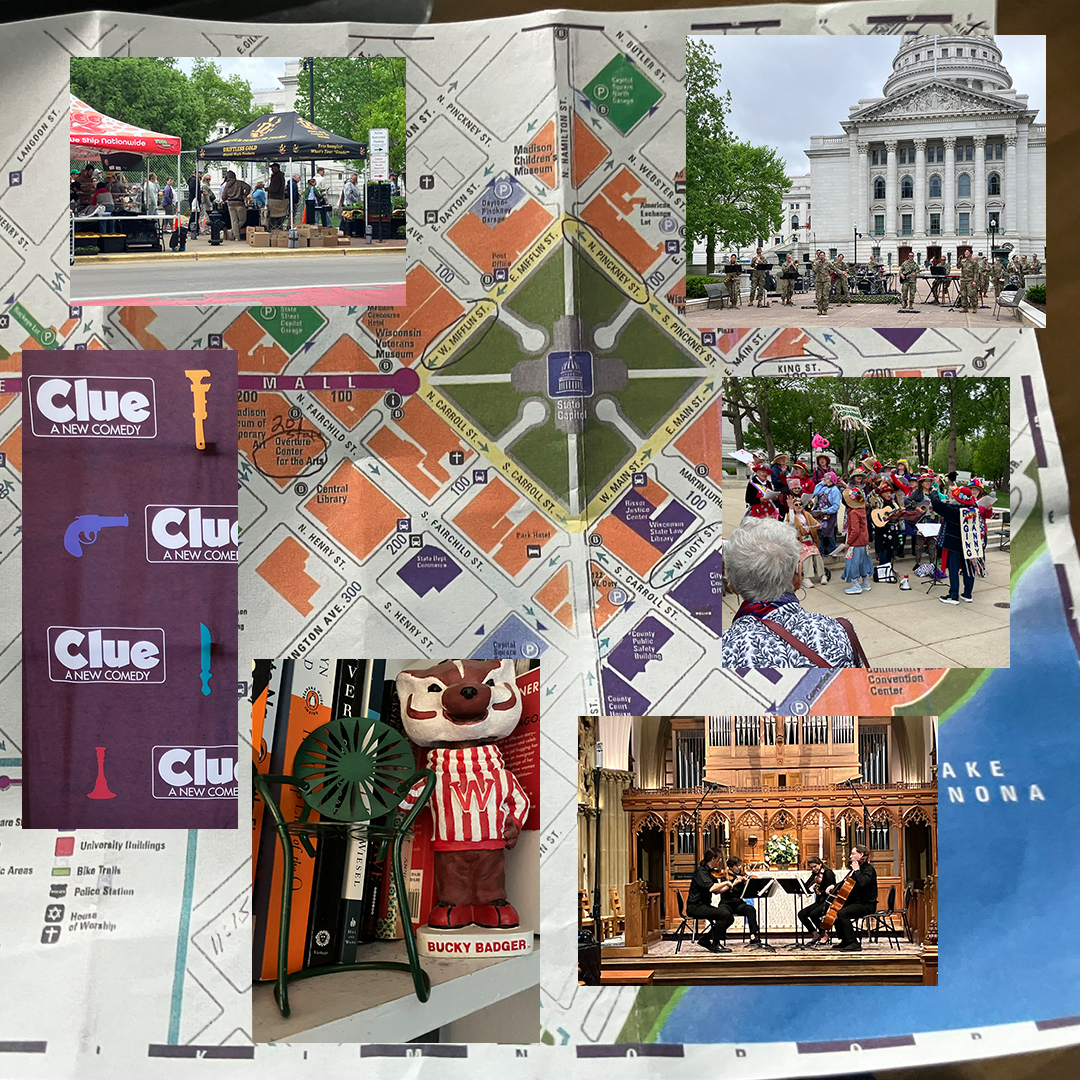
(Sharon’s photo illustration)

The Saturday after I got home, I went up to Madison with my sister and women’s group from an area church. We strolled around the capitol square for the weekly farmer’s market. In addition to some amazing looking vegetables, garden plants, cheeses, and so much more, we got to listen to various protests groups (respectfully placed across the street from the market), and some musicians, including Cover Fire from the 132nd Army Band and the Raging Grannies. After a great early lunch at Barrique’s downtown, we popped into Grace Episcopal Church on the Capitol Square for a free noon concert by the local Ancora String Quartet. And finally, before we headed to the Overture Centure for a performance of Clue, a genuinely funny new comedy, we strolled down the block of crafters and I finally found a UW Wisconsin Terrace Chair to go with my Bucky Badger bobblehead.

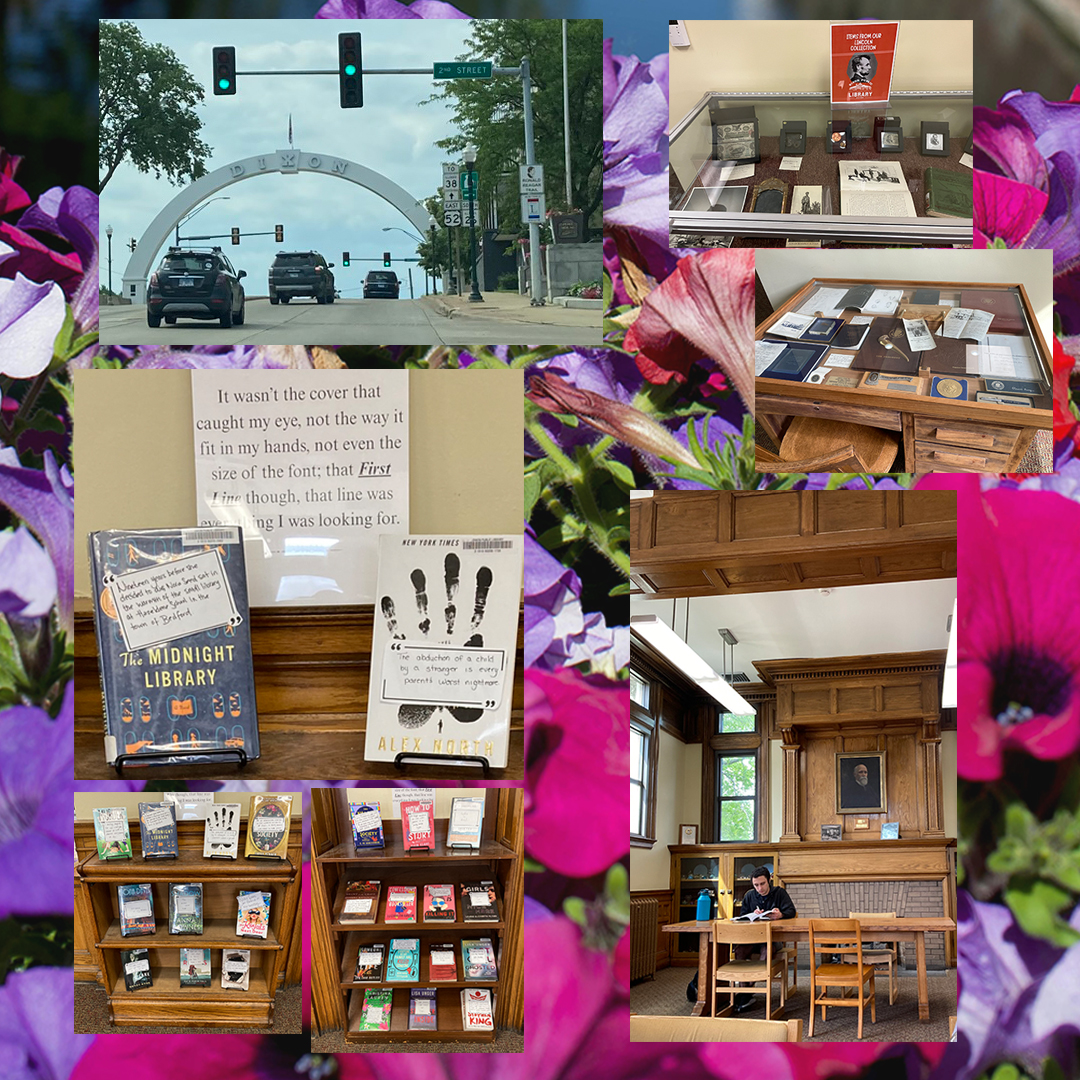
(Background petunias by Valeska Huyskens on pexels.com; foreground images by Sharon)

The next week, I finished proofreading the last 287 pages of contest winners (see last week), and on successive days, I made it to my local writing group, my League of Women Voters International Studies discussion, my Shakespeare Society meeting, Temple Beth El’s annual Food O Rama fundraiser (to buy hot dogs, pickles, challah bread and blintzes–yum!), lunch with a writing buddy, and the next day with my daughter and friends, followed by book club. And that week ended with a Saturday drive to Dixon, Illinois, the petunia capiltal of the state and host of the annual Petunia Festival. (Mark your calendar for July 3-6.) I joined a few writing friends and we spent three hours at the library working on writing projects. (Yes! I got a new short story started!) We also looked at their Abraham Lincoln and Ronald Reagan displays, the gorgeous 1899 building. While it resembles some Carnegie libraries, that is probably due to the architectural styles of the day, but Dixon’s benefactor was local resident, O.B. Dodge. His picture hangs above a fireplace on the main floor. We really loved the display of “hidden” book covers showing the first lines of several books. As readers, we thought it was a great way to lure folks to the books. As writers, we were reminded of how important those opening words really are.

(Sharon’s photo)

Sunday, I shopped for our family cookout on Monday, which turned out to be a beautiful, sunny day.. Tuesday, I had an oil change and today I have more errands to run.

But, for those who have yet to celebrate Memorial Day, remember it was originally marked on May 30. So you still have a bit of time.

As for me, I am ready to flip the page to June. And keep working on that new short story.

À bientôt!

Short stories are fun

(Pexels photo by Ron Lach)

But that doesn’t mean they’re easy.

Some writers I know have said short stories are much harder than novels because you have to make every word count.

I just happen to have a long-standing love of the short story that started when I discovered science fiction magazines when I was in high school. That’s when I wrote my first short stories, all centering around sci-fi topics.

When my kids were little, I read mostly magazine short stories for the same reason I had a subscription to Reader’s Digest. I could devote a few minutes to reading after the kids went to bed or between tasks. I could get a beginning, middle and end in one sitting, something impossible with a novel.

When I discovered audio books that I could listen to on my commute, I did get back into novels and longer non-fiction, which pushed short stories into the background of my reading and writing. But in the past couple of years, I’ve rediscovered the format and jumped back in.

I’ve submitted short stories to a few anthologies, and won a spot in the Guppy anthology, Gone Fishin’: Crime Takes a Holiday. For those, I wrote stories, and sent them into the virtual slush pile for editors to evaluate without knowing who I am. For this story, third time was a charm, and I got to work with editor Jim Jackson of Wolf’s Echo Press, who really helped me improve the final version of “Blood on the White Rose.”

I’d already run several iterations of the story through my critique partners. Four in particular kept telling me the story on the page wasn’t the story I kept saying it was. Finally, days before the submission deadline, they got through to me. At least they spurred me on to rewrite the entire story, bringing forth a more fleshed out main character, and cutting the duration of the events. In its first version, the story took place over a period of weeks. In the end, it lasted something under 24 hours.

What really intrigues me about the OCWW process, though, is the attention to the story before it ever sees an editor. I was assigned to a critique group, given a deadline of March 20 to submit a draft, and received copies of my critique partners’ stories to review before our first critique meeting on April 1.

Of course, I had more than one short story I thought might fit the anthology theme: I didn’t see that coming. I sent two and asked the group to help me select one for my final focus. We’ll see what they say, because I will need to make a first round of revisions before our next meeting, April 17.

But we have until late June to work with each other before our next submission deadline. At that point, we’ll go into a developmental editing process. I have never done anything explicitly called developmental editing, although I may find that’s exactly what I went through with Jim.

I have always imagined developmental editing is something that takes place while the story or novel is in the draft stages with the author. I’m looking forward to being more enlightened as we head toward a 2026 publication of the OCWW anthology. I’ll keep you posted.

À bientôt!