
While I was in Appleton, Wisconsin, earlier this month, I met two women crime fiction writers from New Zealand and England. (But that’s another story.) Neither had a car, so I took them to a couple of places they wanted to visit. One was a shooting range. The other was the Experimental Aircraft Association museum in Oshkosh.
At the EAA museum, we went our separate ways to explore the huge museum and its many exhibits. I was surprised to find two areas of tribute to women aviators. There may have been more, but we only had about an hour to spend, so we kind of flew through. (No pun intended.)
One of the areas was dedicated to the history of the women called WASPs, variously defined as the Women Airforce Service Pilots, Women’s Army Service Pilots and Women’s Auxiliary Service Pilots. (There’s a bit of history at https://www.worldwariiaviation.org/women-air-force-service-pilots-wasp.) Posters showed the history of their service, and some of the things they did during World War II. There was also an example of their uniforms.
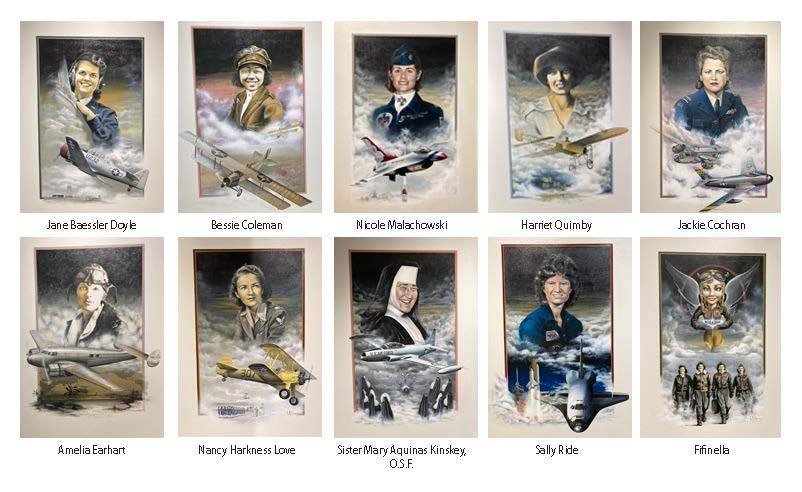
Another area was a walk-through portrait gallery. With these ten women (portraits with this post) were some of the men who contributed to aviation history. Sure, I knew about Amelia Earhart and Sally Ride, and I just learned about Bessie Coleman. But the others were new to me.
Roald Dahl wrote about fifinellas in his 1942 book, Gremlins. They are, he explained, female gremlins who plagued the pilots of the Royal Air Force. Walt Disney illustrated the book and developed the first image of a fifinella. The one at the EAA museum looks different, but her story is the same.
Disney and his empire are picky about the use of their illustrations, but in what I can only assume was generosity borne of the war effort, he allowed his original drawing in the Fifinella Gazette, the WASP newsletter, and to be used — for at least two years — as the official mascot of the WASPs. The initial permission could be renewed upon request.
Apparently (according to a history of the WASPs online), women pilots were already creating unofficial patches to wear on their flight jackets and other attire.
Another surprise to me was learning about Nancy Harkness Love, who was a civilian in the Army Air Force. She commanded the first units of female pilots during WWII. She earned her pilots license at age 16, after she saw Charles Lindbergh and the Spirit of St. Louis in Paris. (He has a section in the EAA museum, too, and there’s a replica of his plane in the exhibit.) Nancy, who later became a Lieutenant Colonel in the Women’s Airforce Service Pilots, earned a commercial pilot’s license in 1932. She flew people around the U.S. Northeast to earn money while a student at Vassar College.
Despite her work, she had to leave college after her junior year because she and her parents couldn’t afford it. She took a job selling aircraft in Boston, then worked as a test pilot for industry and for the Burea of Air Commerce (today, the Federal Aviation Administration).
She also flew across the country to try to convince communities and farmers to paint navigational signs on water towers and barns to improve flying safety.
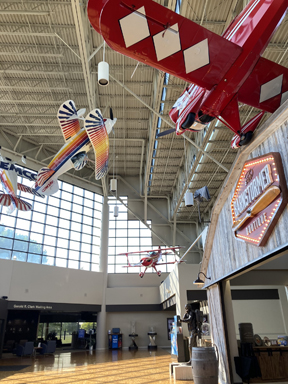
If you plan to visit the Oshkosh area, this is the 75th anniversary of the EAA. That makes it a great year to consider attending the annual Airventure. I think it’s probably the biggest “family reunion” of pilots and flying afficiandos in the world. Check it out at https://www.eaa.org/airventure.
And be sure to make a stop at the museum. I plan to go back.


 sharon p. lynn