Celebrate Poetry Month
Every year in April the Academy of American Poets (AAP) celebrate their literary form for the whole month. As a sometime poet, I love to think about verses, scrawl them in random notebooks, and sometimes try to have them published.
The first poems I ever wrote are lost to me now. My youngest sisters–twins–needed to find a poem to take to school the next morning. I must have been in high school and they must have been in second or third grade. I was the most prolific reader of us four sisters, so they came to me for help.
We looked for a poem in one of the books in the house, but it wasn’t something our parents had. We might have found examples in our World Book encyclopedias, but I don’t think it occurred to us. Or if we did check, there were no poems for kids.
I fondly remembered checking out A Child’s Garden of Verses by Robert Louis Stevenson when I was younger. I hadn’t, however, memorized full poems, so I couldn’t write any of them down for my sisters. Instead, I sat down and wrote them each a poem. One, if I remember right, was about a frog and one about a cat. I copied them neatly and gave one to each sister to take to school the next day.
They came home without the poems, but with a question from the sister who was their teacher that year. Could she keep the poems? What could I say but yes?
So, when Sister Mary Somebody, OSF, died, someone probably threw them away. I mourn the absence of those poems in my life. The memory of helping my siblings, and the pride I felt that a teacher liked my poems well enough to want to keep them, are strong.
I think, as small as that encouragement was, it made me believe I could write poetry, so I kept it up. My later rewards were publication in college literary magazines, including a first place award for one of them; selection for a writing group’s publication, and compliments from a poet I admire in one of her workshops.
I still write when I feel like it. Not much recently, but from time to time I challenge myself to try a new haiku. I think that spare form–seventeen syllables in lines of five, seven, and five–is my favorite.
Iambic pentameter, by the way, is the name for any poem that has lines with the rhythm ta-DUM ta-DUM ta-DUM ta-DUM ta-DUM. It’s just one of hundreds of poetry forms that you can try. Writer’s Digest magazine has an online list of many of the poetic forms. More than most folks who are fans of limericks would ever want to know. (Remember, “There was an old man from Cork….)
I remember falling in love with e.e. cummings, and the freedom he claimed for himself in poems with no capital letters. Imitating him in a high school class prompted my teacher to tell me I had to know the rules before I could break them. (She did let me get away with uncapitalized poems in that class.)
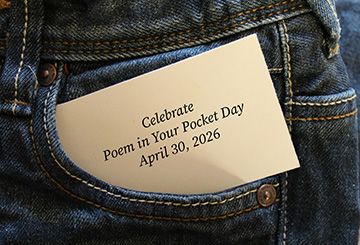
One of the AAP Poetry Month celebrations is Poem in Your Pocket Day, which will be April 30, 2026. It was initiated in New York City schools in 2002. AAP took over the celebration in 2008. There are official rules (check the link above), but you don’t need to follow them if you just want something you can pull out of your pocket anytime. Something to inspire, amuse, or comfort you. Something you can enjoy alone or share with friends.
For years, I had a creased copy of an Ogden Nash poem in my wallet. I remember typing it on the typewriter my parents gave me for high school graduation, cutting it from the paper and tucking it in change pocket. It was only a few lines long, which is ideal for a poem in your pocket.
It’s poetry month. Read one today at the AAP home page or at the Poetry Foundation.
À bientôt!