Election reflection

Or why I trust election results

While I was on my big road trip in September, I got to see political ads from places where the races are hotter–and PACS and people are spending way more money–than they are near me.

And I know some people are distrustful of the election process. Frankly, I’m not. And here’s why.

I started covering elections before I was old enough to vote. I also got to help in the preparation for a community college referendum.

For the referendum, the college had to foot the bill so part of my job was counting–exactly–the paper ballots for each polling place in the district. It was tedious work, but we had to be precise because we had to ensure that there could be no cheating. No mistakes. No chance for election fraud.

A few years later, I started covering elections in my first jobs. I liked setting up questionnaires for candidates and running them so voters could compare the answers. And I got to show up at one courthouse or another on election night to collect the vote totals.

When a friend of mine took a new job, he recommended me for a national news service that collected election night totals for wire services, as well as print and broadcast media outlets. I never minded waiting until after midnight for the final counts.

It was on election nights, back when a room full of journalists and freelancers would sit around a table in a crowded room, vying to be the first to grab one of the half-dozen phones–back in the landline days–that I learned about election delays and tallying problems.

We learned that the closes polling places to the clerk’s office would usually get counted first. The amounts could be so tiny they would be swallowed up in the later, bigger polling place results.

I learned about snags with voting machines that could slow the counting by long stretches of time while people in the counting room would work to fix whatever jammed one machine or another.

I was never in the counting room, but I accepted the explanations the clerk’s office gave us for the slowdown in releasing results.

I understood that the results, while accurate, didn’t include write-in votes. Those got tallied last and didn’t usually amount to much. Those totals, in fact, were unofficial. They wouldn’t become official until the governmental units–city councils, village boards, school districts, county boards, and so forth–accepted them by the end of November. I can remember going to a few meetings at the end of the month that were scheduled especially to accept the vote counts and determine who (or what referendum) won or lost.

It was that local approval of votes that got passed on to state officials so lists of the folks in charge of our many pieces of government would be accurate.

It was those county results in presidential and Congressional elections that would go on to the state voting authorities to be accepted by them and passed up the ladder to Washington. Illinois’s vote certification day is Dec. 4, 2026. (For other states, check Ballotpedia.)

Congress is scheduled to convene on Jan. 3, 2027, to seat the new House and Senate members.

At that point, the election is official. And over.

Maybe I’m lucky to have lived my entire life in Illinois, and to have had a chance to meet and get to know quite a few county clerks in my newspaper work. But I have yet to meet one who hasn’t taken her or his job seriously when it comes to making sure elections are absolutely fair and error-free.

I even got to hear a presentation–through the League of Women Voters–from the Illinois Election Commission about what they do with the results and how they work to ensure the elections in my state are accurate.

I also have friends from around the state–including in Chicago and Cook County–and I have yet to hear any stories of proven election fraud or of attempts to subvert the process.

Sure, my information is anecdotal. I’ve never looked into voter fraud in any kind of scientific or rigorous way. But my reporting goes back way into the last century. And despite being out of the election coverage loop, I have yet to hear that anything untoward or illegal has happened in my area.

And I am willing to extend my trust to the rest of the country. (And to today’s media and election oversight groups to verify my trust.)

If you want to know more about who runs the elections in your area, I recommend the League of Women Voters as a starting point. And most county clerks and other election officials aren’t opposed to meeting the folks who elected them, and for whom they work. Find out what their office hours are and go say hello. The next week will be pretty busy, so they might appreciate it if you wait until after Nov. 3. But there will be other elections.

Heck, go to a board meeting. Most are boring, but you can learn how they work before they find themselves in the midst of controversy. You can also learn what each board is supposed to handle, how much of your tax dollars they get to spend, and just what the board has direct control of.

Be a smart citizen, and do a little of your own oversight.

À bientôt!

Turning pages, making changes

Canva image

For some reason, I’ve been feeling a bit sentimental with this year’s calendar change. In part, I know, it’s because the employer I retired from is apparently finally convinced I’m not coming back. I went in to finish cleaning out my office space a couple of months ago, and my (dot)org email seems to have been disconnected recently.

Yes, I did just get a note late last week from someone who wanted to publicize a chili supper. The “outside world” hasn’t quite forgotten me. But I passed him on to my more-than-able successor. (And it may mean my old phone number is still connected, too.)

Another “milestone” this year was realizing I’ve been doing a prompt blog (January, OUR Writing Month) for ten years now. I’ll wrap up the eleventh year in a couple more days. I have thought for some time that once I had 366 prompts, I could quit. I think I crossed that mark this year, but now I think an even dozen would be a better place to end the tradition. I’ll see how I feel about it next December.

Realizing how long I’ve been doing “JanO,” I started to wonder how long I’ve kept this blog going. September 2025 marked 13 years since I launched it. And I still haven’t published a novel. (Can you hear my rueful laughter?)

That sent me back through some old blog post drafts. I found a few that I finally hit “publish” on, which is why some of you got several in a single day. (No, I wasn’t hacked.)

About the same time, I started this blog, I also started participating in the now-defunct National Novel Writing Month. I didn’t “win” every year, which means I didn’t manage to write 50,000 words in November. But I have the start of more than a dozen novels, and fairly full drafts of several of them. I’ve been playing around with revisions for three of the novels since then. I’m working on one of my favorites right now and hope to have a good version by the end of February. (If you don’t see me much next month, you’ll know why.)

I started this novel–working title, Lovely, Dark and Deep: A Fever River Mystery–with an eye toward writing a cozy mystery from the point-of-view of the main character. But I don’t have the funny bone that some of my favorite cozy writers have and I was getting too “dark.” I gave up and decided to call it a traditional mystery. In an early revision, I decided I wanted to add some accurate policing details, and thought I needed a second POV. But I wrote that POV in third person. Now I’m trying to make the whole novel third person and I’m toying with adding one more POV. We’ll see how things go.

Sharon’s pic

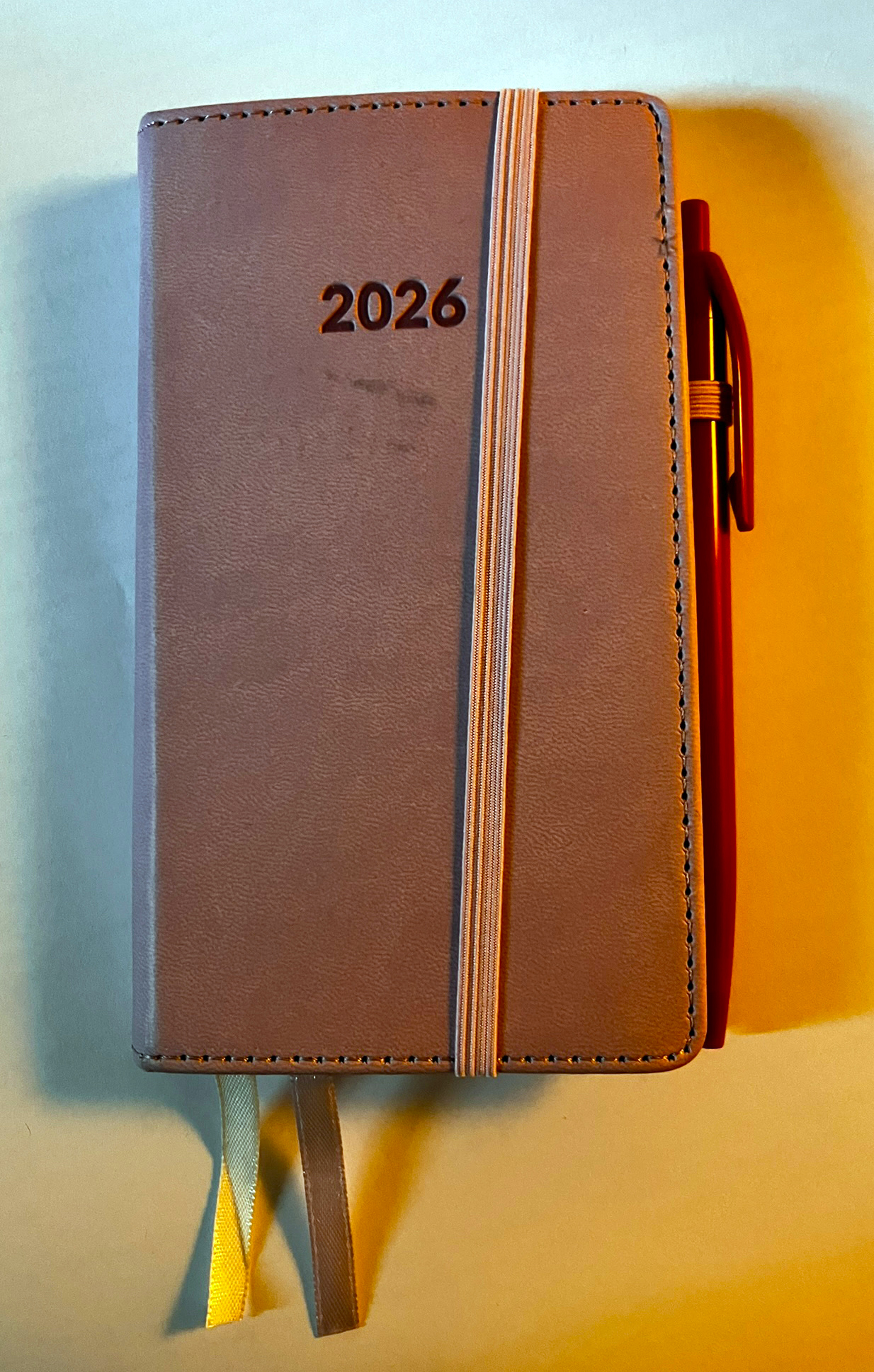
Anyway, I have new calendars on the walls. The main one is next to me in my writing corner. And I have a new pocket calendar that I can drop in whatever bag I’m using when I leave the house. It started out a lovely shade of pink but it’s already showing wear. I may have to consider a darker color next year.

I also updated my planning grid. It’s a spread sheet with a 24-hour grid for seven days. Recurring events, like my writing times, are blocked out. I’ve got a great routine of online writing times Monday through Saturday. Most are with friends who live in Illinois and Wisconsin, say, within a hundred mile radius of my house (although one is in Champaign). The Friday bunch is headquartered in Montreal, Quebec, and on Saturday group members could be from anywhere in 13 Midwestern states (as defined by Mystery Writers of America).

I just joined a group from the Shut Up & Write community. I needed an early afternoon “push” in the middle of the week, and a wonderful gentleman in Scotland hosts a Wednesday session that starts at 12:30 p.m. in my time zone. I’ve only attended a couple of times, but it seems to be just what I needed.

So, yeah, the calendar changed. And I’m looking back and looking forward today.

Here’s to a good year for you and for me!

À bientôt!

Death knell for news

My hometown newspaper died Aug. 6, 2025.

No cause of death was reported as the news flew through social media, but I suspected sagging subscriptions and ad sales, coupled with rising materials costs as likely culprits in its demise. A press release reported later by area television stations and a regional daily said as much.

One more small piece of the formerly ubiquitous press is part of history. And I find it saddening for many reasons.

It was the first place I ever saw my words in print. In grade school, after I learned to read, I scanned every newspaper and magazine that came into our house. There were lots. We had a subscription to the now deceased local paper, which was actually two papers. The News and The Leader carried separate nameplates when I was growing up. The News was printed on Tuesday, with home mail delivery on Wednesday. The Leader came out Thursday, with Friday delivery.

(Pexels photo, Maxim)

I read lots of the articles, and looked at all the pictures. When I was elected scribe of my Camp Fire group in fourth grade, I copied the format of the new officer announcments from the adult clubs and wrote a short article. I recopied it in my best penmanship, carried it the four blocks from my school to the newspaper office, and handed it in. A week later, I read it in the paper. I remember the editor changed one word. (I learned early not to be too attached to my prose.)

The firt time I worked with a newspaper photographer was after I wrote to an area daily’s kids’ column, “Ask Andy.” I’ve always suspected my question was drawn from a hat, not selected because it was so interesting. But I won a set of World Books, which I still have despite its being hopelessly out of date. I remember going to the local newspaper office, the same one I carried articles to, for a photo shoot. The picture still shows up from time to time on my hometown museum’s Facebook post.

I grew up respecting our local newspaper photographer. We all knew to step over the cables in the high school gym because he brought extra lighting to the basketball games so he could get good shots. By the time I was taking sports pictures for the paper, we had strobe flashes for the cameras we carried but I don’t think our shots were as good as his.

I kept writing stories for school groups, from the seventh-and-eighth grade civics club to high school drama club, walking them downtown, and seeing my stories in print. I guess it’s no wonder I kept writing for newspapers for a good chunk of my life.

My first full time job was at that newspaper. I started in the backshop as a typesetter, eventually graduating to page design. I also got to help fix page negatives with a special red pen, “stuff” papers coming off the press, counting and tying them as I went. I could flip a stack of 100 papers back then. I even got to help change “dink” rolls on the press.

My boss in the back shop knew my goal was to work up front, so he helped me organize my schedule to attend classes at Northern Illinois University. Eventually I got a journalism degree there, but not until after my hometown paper had been sold to a young man my age who had dreams of building a nationwide newspaper group. He hired me as an editor for a county weekly, also owned by my hometown paper.

That was 1975. And 50 years later, his company closed, shuttering the papers in Rochelle, several other small towns in Illinois and in other states throughout the U.S.

But he really ended a tradition in my hometown that started in the 1800s. There were newspaperswhen the town was called Lane, before railroad progress required a name change. The Lane Leader ran from 1858 to 1859. The Lane Register was published from 1863 to `1865. The University of Illinois Newspaper Project says Lane changed its name to Rochelle on April 10, 1872.

The earliest papers I could find labeled Rochelle were the Herald, 1865-1877, and the longer-lasting Register, 1865-1926, although both seem to predate the changing of the town’s name. I think the records just include some of the Lane years.

The Library of Congress lists 1921 for the founding of the Rochelle News. According to the U of I Newspaper Project database, the Rochelle News succeeded the Rochelle Independent and the Rochelle Register when those nameplates died in 1926.

The News went into business with the .Rochelle Leader in 1934 but each continued under its own nameplate until 1994 when the two papers became the Rochelle News-Leader under the ownership that just closed its doors.

Sadly, no services have been scheduled to commemorate the loss.

À bientôt