
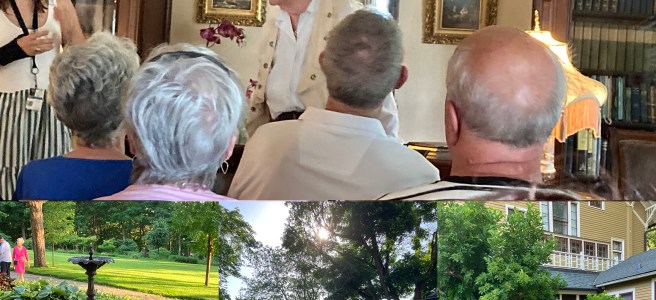
In one whirlwind day this month, I attended a writers’ conference and met “Agatha Christie” in southeast Wisconsin.
When I heard about an Agatha Christie “evening” as a fundraiser for the Wisconsin Historical Society, I wrongly assumed it would be at the Historical Society Library on the UW campus in Madison. But when I figured out she would be performing in Lake Geneva, I bought a ticket anyway. The drive would be a little more than an hour from my house, not the forty-five minutes to Madison, but not a stretch.
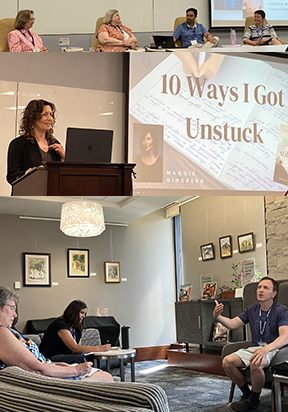
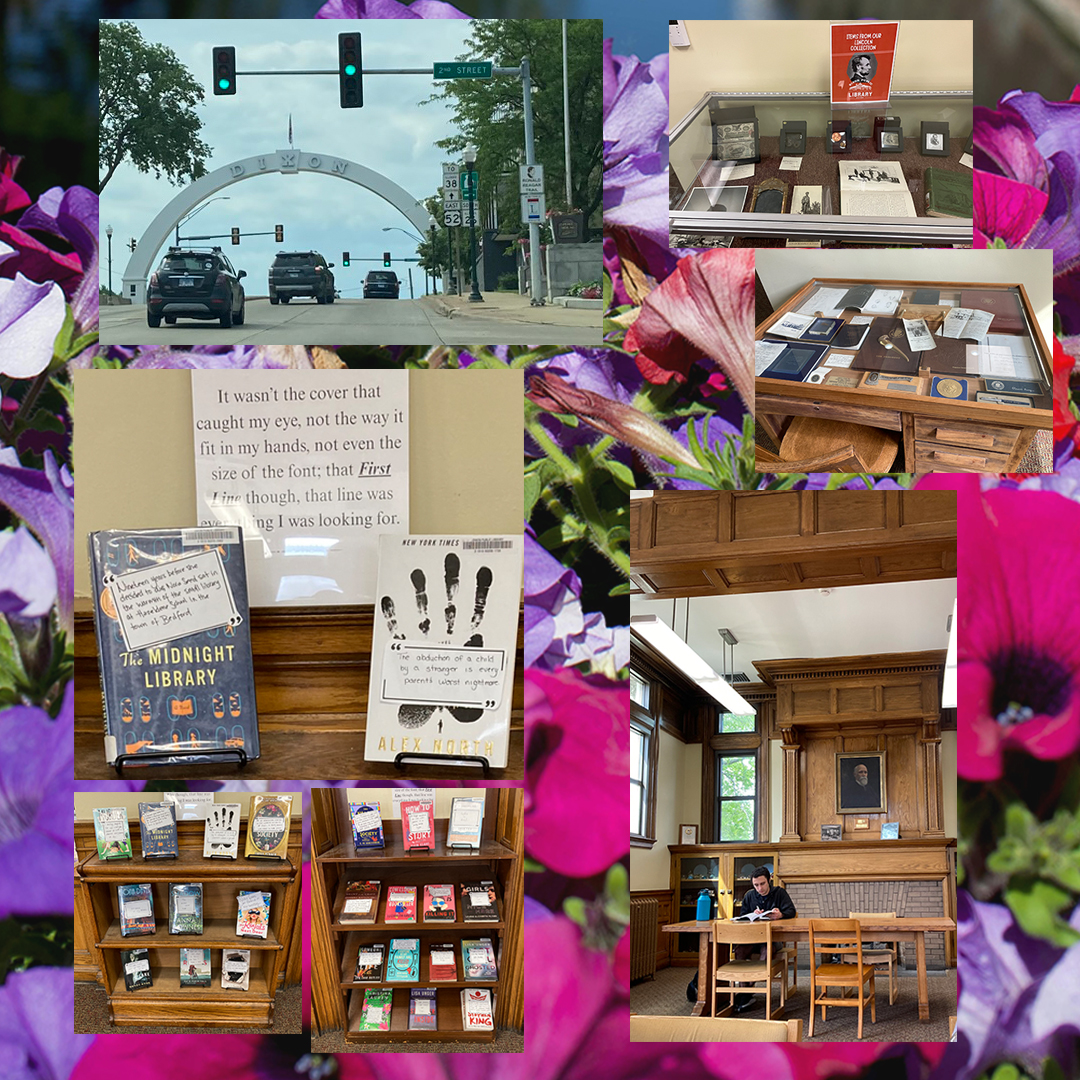
A few weeks later, friends told me they were taking part in Book Fest in Janesville, Wisconsin, a faitly new summer event sponsored by the Hedberg Public Library. And it was free! Scheduled the same day as Agatha’s visit, I RSVP’ed for two of the Book Fest events. It was also about forty-five minutes from my house. (Lake Geneva would be about thirty minutes from there.) It was going to be a scorcher, so I was looking forward to a day out of the sun.
Happily, the drive over was a bit quicker than I though and I arrived in time to sneak into the end of a session I hadn’t signed up for. That was “Everything You Need to Get Started” with Ken Brodsy in the Fireplace room. The gatherine was in an almost living room-like meeting place at one end of the main library room. He had some great tips, even at the end, and a plotting handout I was happy to take home.
I’d signed up for “Bringing Your Manuscript to Port: Navigating the Varied Channels to Book Publication.” Two of my Wisconsin Sisters in Crime–Christine DeSmet and Peggy Joque Williams, were on the panel, but so was Kristin Oakley, a friend from a now-defunct writing group in Rockford. She’d moved to Madison and I hadn’t seen her in years.
The moderator and fourth panelist, Ken Humphrey, is also the man behind the Wisconsin Writers Association email, hello@wiwrite.org. (I love the domain name. After all, the only answer to “wiwrite” is why not?) Ken and I had been exchanging email about the WWA fall conference and my membership listing. He has resolved everything with aplomb.
Each of the four panelists followed different routes to publishing from traditional to hybrid to independent (self-), and they shared boons and banes of each path. They also had some great handouts.
I ordered the optional delivered lunch but got so busy chatting with the other woman at my table, and the morning snacks had been so good, that I barely ate it. She and I stayed put for the master class with Maggie Ginsberg, Madison author of Still True, which won the 2023 WLA Literary Award for Fiction and received an honorable mention for the 2022 Edna Gerber Fiction Book Award. Her talk on “10 Ways I Got Unstuck” was full of great tips for writers in any literary genre. And, of course, there was a handout. (Do you sense a pattern in my enthusiasm?)
I think my favorite was her reminder that it’s not fair to compare a work-in-progress to another author’s finished, published work. It’s messy before those final edits, no matter who you are.
After Ginsberg’s talk, authors lined the halls at tables piled with their books and swag, and library patrons had a chance to mingle, chat, buy books and get autographs. Kudos to Janesville’s Hedeberg Public Library for putting on such a great event for four years. Hope they can keep it up.
But, by now I was hungry, so I went downstairs to The Ground Floor, the Friends of the Library’s coffee and book resale shop. I bought some tea and finally had a chance to eat my lunch before heading toward Lake Geneva.
I detoured through Delavan, another cute southeast Wisconsin town, before following my GPS to a small country school that felt like it was in the middle of nowhere. As far as I could tell, I was nowhere near downtown Lake Geneva. The school was surrounded by fields, with nary a house in view.
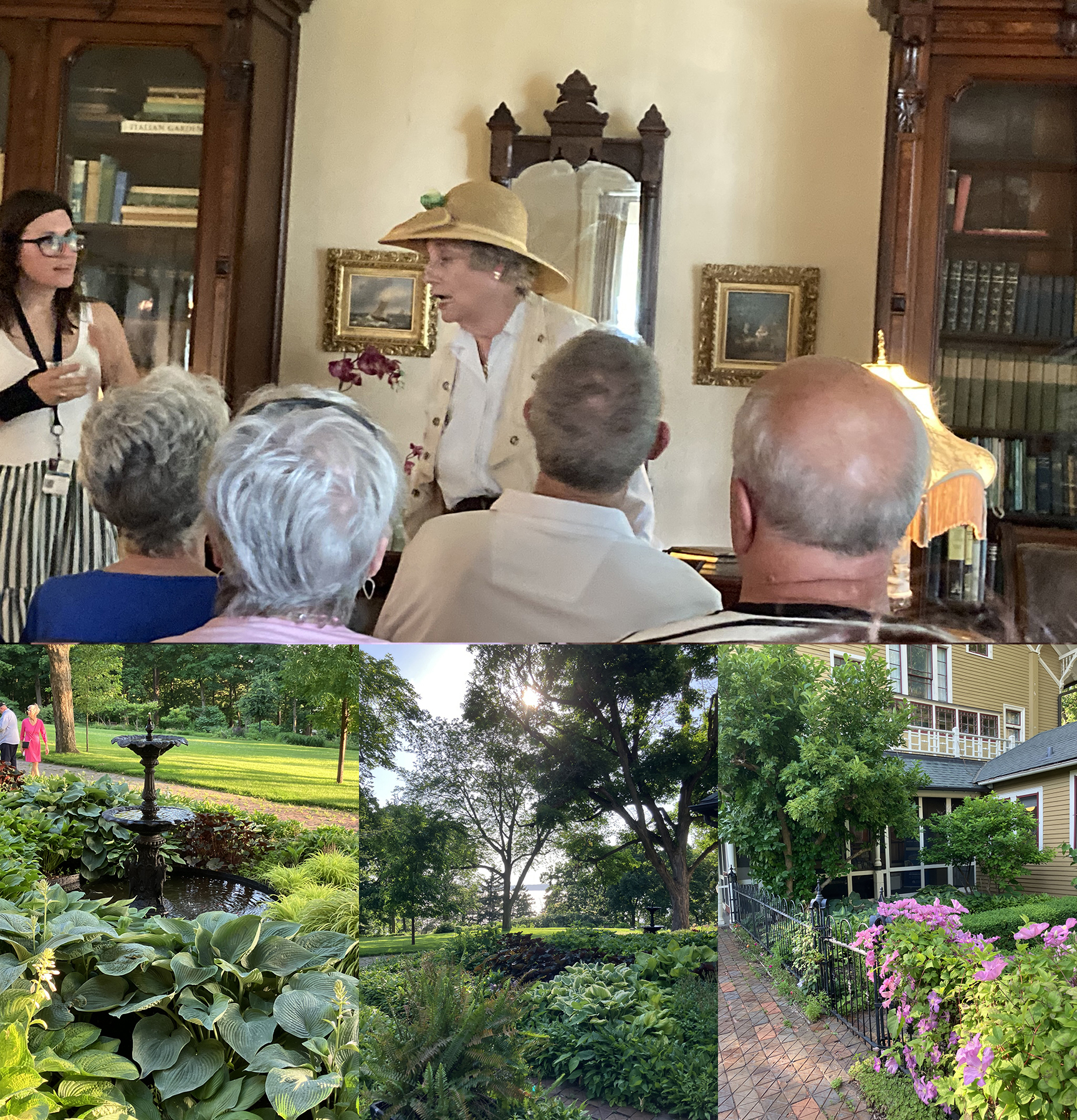
The part I hadn’t noticed in my email with the ticket was that the school was a staging area for a shuttle to the actual performance location. Agatha was visiting Black Point Estate and Gardens on Lake Geneva, not someplace in Lake Geneva.
There were few enough at the talk that we caravanned through winding, shaded country roads to the estate. We had wine on the porch facing the lake before moving into the un-air conditioned 1888 home built for a Chicago “beer baron.” At that time, the rail service could get him from his summer retreat in Wisconsin to Chicago in about an hour.
The fence and gardens near the house reminded me of Monet’s Giverney in France, but the family wasn’t as interested in backdrops for painting as they were in fun at the lake. From the lawn near the house, you could see the sparkling water between trees at the bottom of the rolling lawn. Visiting during regula hours might be worth a trip back to the estate someday.
But I, and a couple dozen other folks, had come to meet Agatha. Local historian and actress Chris Brookes brought a circa 1950 Agatha to the event, sharing elements of her life and writing to that date. She’ll be doing another presentation Sept. 20 at Black Point, in case you’d like to hear her. It was fun. She read from a couple of her books, occasionally strolled back into the audience, and asked them questions.

After the performance, we could wander around the first floor and gardens. It made for a lovely evening, and I managed the drive home before sunset despite dawdling along the way. I even stopped in Sharon, Wisconsin, for a selfie. (I was tempted to bring a bucket of soapy water back to town, but I haven’t done it yet.)
Day trips can be lots of fun, can’t they?
À bientôt!
 sharon p. lynn