May is departing in haste this year. At least from my perspective.
I started the month by ending my trek from Malice Domestic in Bethestda, Maryland, to Alabama to visit my son and his family. The trip was generally uneventful, but I’m not a long-distance driver. Oh, I drive long distances, but I break up the trip over multiple days. Fortunately, the weather was generally good for all my spring travels.
I stuck around a week, had lots of fun with kids and grands, and got a Mother’s Day gift a week early when my son took me to Atlanta to see a wonderful production of Wagner’s opera, Siegfried. For those who don’t know the opera, think dark fairy tale with an evil, troll-like blacksmith; a youngish lad destined to become a great warrior who wields the sword of power; a wizard akin to Sauron who ruled Mordor in The Lord of the Rings; the wizard’s wife who is effectively a prisoner of the tower wating for the Fates to release her; and a female warrior who has fallen in battle and who needs her prince (hark back to the young warrior) to come and awaken her so they can fall in love. A perfect story for a kid who grew up watching “He-Man and the Masters of the Universe” cartoons on TV.

In this production, the sets varied from dark views of what could be the interior of the Death Star in Star Wars complete with heavy steam punk overtones to mountaintop fantasies that only lacked dragons threating, and hosts of fairies circling, the lovers. I enjoyed every minute of the four-hour opera, even when I got caught up in the music and forgot to read the translations of the German. (My German was never good enough to get me through an opera, but I’m afraid it’s so rusty now I hardly picked up a single word.)
Ok, so that was just part of great week with my farflung family.
I’d been putting off so much during the three weeks I was away that I should have jumped in as soon as I go home to try to catch-up but I just vegged the whole weekend and didn’t plunge into my third short story draft for until Monday. Got that done and off to the critique group, then read the newest versions of the other writers’ tales with twists. Right before I dug into 140 pages of another friend’s cozy novel draft. I had critique meetings online for both sets of pages in Thursday.
But in the meantime, I also received the first 120-or-so pages of awards and judges’ commentary for a journalism organization I’m still part of. I have volunteered to proof the monthly newspaper, and the June issue is always devoted to the awards presented at the annual conference. Got those read by Friday, just in time to make my 10 a.m. dentist appointment.

The Saturday after I got home, I went up to Madison with my sister and women’s group from an area church. We strolled around the capitol square for the weekly farmer’s market. In addition to some amazing looking vegetables, garden plants, cheeses, and so much more, we got to listen to various protests groups (respectfully placed across the street from the market), and some musicians, including Cover Fire from the 132nd Army Band and the Raging Grannies. After a great early lunch at Barrique’s downtown, we popped into Grace Episcopal Church on the Capitol Square for a free noon concert by the local Ancora String Quartet. And finally, before we headed to the Overture Centure for a performance of Clue, a genuinely funny new comedy, we strolled down the block of crafters and I finally found a UW Wisconsin Terrace Chair to go with my Bucky Badger bobblehead.
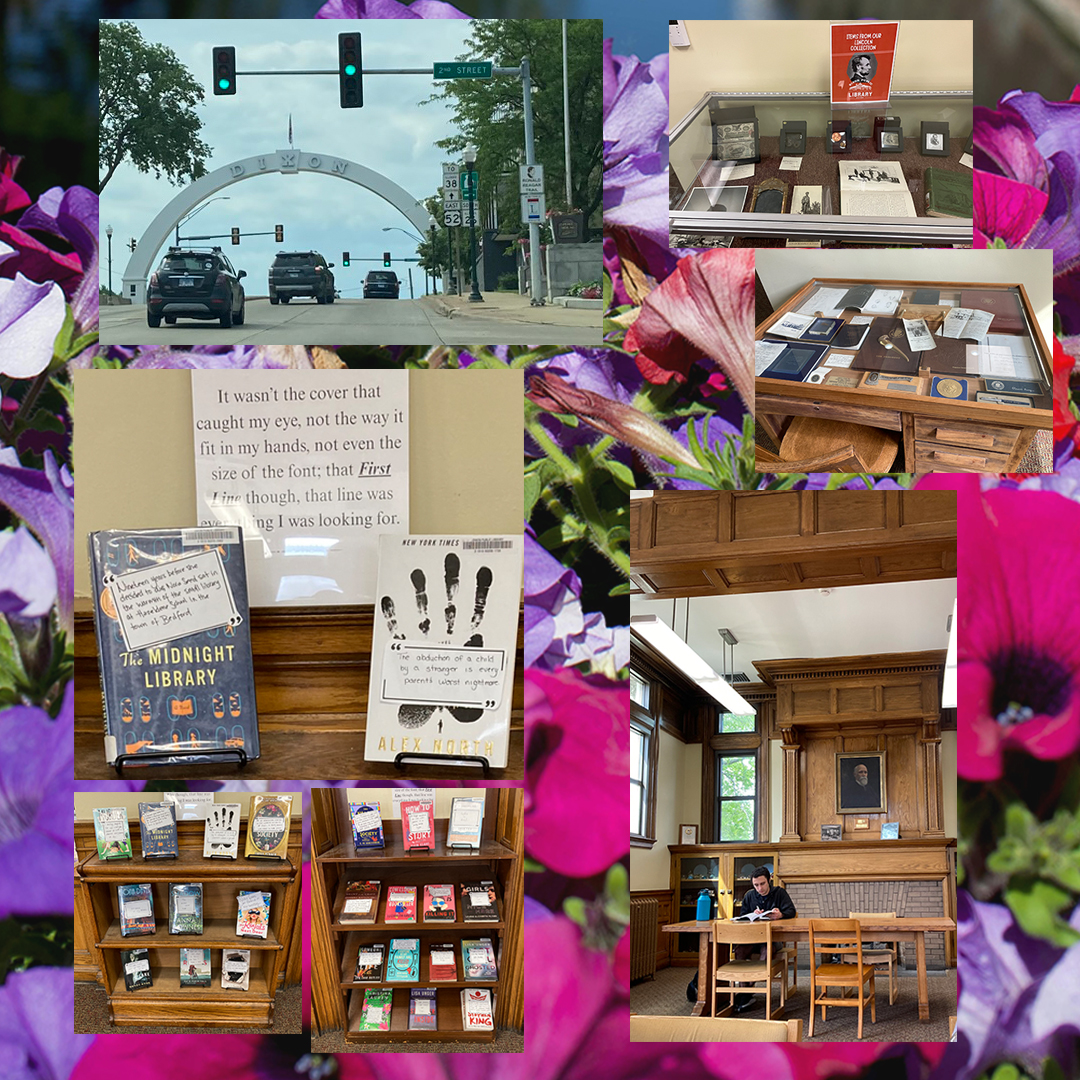
The next week, I finished proofreading the last 287 pages of contest winners (see last week), and on successive days, I made it to my local writing group, my League of Women Voters International Studies discussion, my Shakespeare Society meeting, Temple Beth El’s annual Food O Rama fundraiser (to buy hot dogs, pickles, challah bread and blintzes–yum!), lunch with a writing buddy, and the next day with my daughter and friends, followed by book club. And that week ended with a Saturday drive to Dixon, Illinois, the petunia capiltal of the state and host of the annual Petunia Festival. (Mark your calendar for July 3-6.) I joined a few writing friends and we spent three hours at the library working on writing projects. (Yes! I got a new short story started!) We also looked at their Abraham Lincoln and Ronald Reagan displays, the gorgeous 1899 building. While it resembles some Carnegie libraries, that is probably due to the architectural styles of the day, but Dixon’s benefactor was local resident, O.B. Dodge. His picture hangs above a fireplace on the main floor. We really loved the display of “hidden” book covers showing the first lines of several books. As readers, we thought it was a great way to lure folks to the books. As writers, we were reminded of how important those opening words really are.
Sunday, I shopped for our family cookout on Monday, which turned out to be a beautiful, sunny day.. Tuesday, I had an oil change and today I have more errands to run.
But, for those who have yet to celebrate Memorial Day, remember it was originally marked on May 30. So you still have a bit of time.
As for me, I am ready to flip the page to June. And keep working on that new short story.
À bientôt!