Female flyers worth celebrating

(Sharon’s illustration)

While I was in Appleton, Wisconsin, earlier this month, I met two women crime fiction writers from New Zealand and England. (But that’s another story.) Neither had a car, so I took them to a couple of places they wanted to visit. One was a shooting range. The other was the Experimental Aircraft Association museum in Oshkosh.

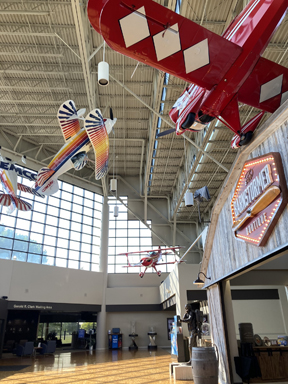
At the EAA museum, we went our separate ways to explore the huge museum and its many exhibits. I was surprised to find two areas of tribute to women aviators. There may have been more, but we only had about an hour to spend, so we kind of flew through. (No pun intended.)

One of the areas was dedicated to the history of the women called WASPs, variously defined as the Women Airforce Service Pilots, Women’s Army Service Pilots and Women’s Auxiliary Service Pilots. (There’s a bit of history at  https://www.worldwariiaviation.org/women-air-force-service-pilots-wasp.) Posters showed the history of their service, and some of the things they did during World War II. There was also an example of their uniforms.

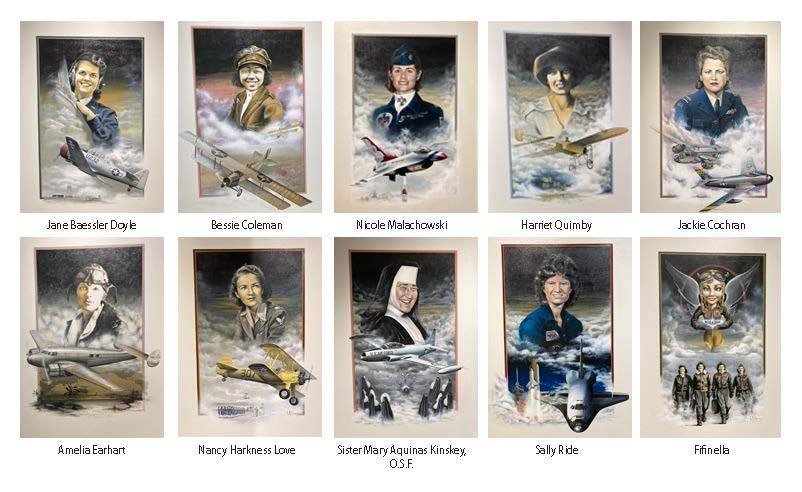
Another area was a walk-through portrait gallery. With these ten women (portraits with this post) were some of the men who contributed to aviation history. Sure, I knew about Amelia Earhart and Sally Ride, and I just learned about Bessie Coleman. But the others were new to me.

Roald Dahl wrote about fifinellas in his 1942 book, Gremlins. They are, he explained, female gremlins who plagued the pilots of the Royal Air Force. Walt Disney illustrated the book and developed the first image of a fifinella. The one at the EAA museum looks different, but her story is the same.

Disney and his empire are picky about the use of their illustrations, but in what I can only assume was generosity borne of the war effort, he allowed his original drawing in the Fifinella Gazette, the WASP newsletter, and to be used — for at least two years — as the official mascot of the WASPs. The initial permission could be renewed upon request.

Apparently (according to a history of the WASPs online), women pilots were already creating unofficial patches to wear on their flight jackets and other attire.

Another surprise to me was learning about Nancy Harkness Love, who was a civilian in the Army Air Force. She commanded the first units of female pilots during WWII. She earned her pilots license at age 16, after she saw Charles Lindbergh and the Spirit of St. Louis in Paris. (He has a section in the EAA museum, too, and there’s a replica of his plane in the exhibit.) Nancy, who later became a Lieutenant Colonel in the Women’s Airforce Service Pilots, earned a commercial pilot’s license in 1932. She flew people around the U.S. Northeast to earn money while a student at Vassar College.

Despite her work, she had to leave college after her junior year because she and her parents couldn’t afford it. She took a job selling aircraft in Boston, then worked as a test pilot for industry and for the Burea of Air Commerce (today, the Federal Aviation Administration).

She also flew across the country to try to convince communities and farmers to paint navigational signs on water towers and barns to improve flying safety.
(Sharon’s photo)

If you plan to visit the Oshkosh area, this is the 75th anniversary of the EAA. That makes it a great year to consider attending the annual Airventure. I think it’s probably the biggest “family reunion” of pilots and flying afficiandos in the world. Check it out at https://www.eaa.org/airventure.

And be sure to make a stop at the museum. I plan to go back.
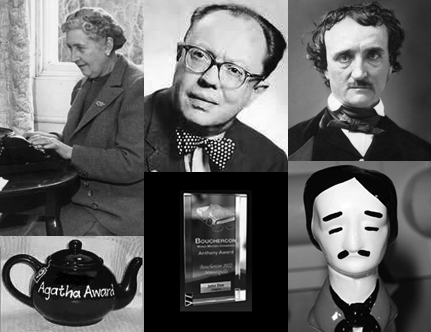
Agathas, Anthonys and Edgars, oh my!

(Sharon’s collage)

Even though I’m still what we call a “pre-published author” in the crime fiction business, right now my life seems to be all about awards.

A year ago I offered to create the program for Malice Domestic, an annual conference where fans and writers of mysteries gather for several days to talk, drink tea, and vote on the Agatha Awards. Yes, they are named in memory of the Dame herself, Agatha Christie.

I’ve put in about a day and half already this week on photos, email, and page designs. Others on the committee are also hard a work writing stories, setting up the sessions, designing ads, and doing countless other tasks that happen behind the scenes to make sure people who attend have fun while they’re there.

The Agatha Awards are hand-lettered tea pots, some black, some white. They suffered a few supply chain problems during the height of COVID, but it looks like the supply is back to normal now.

:Last week, I got my invitation to the Edgar Awards. Everyone who is a member of Mystery Writers of America is eligible to attend the ceremony — black tie, it is — in New York in April. I won’t be going, in part because it happens days before Malice begins, and I’ll be busy in Maryland. The award is a colorful bust of the man considered by many to be the father of mystery fiction in the U.S.

And today, amidst all the Malice email that’s been landing in my box, I also received my invitation to nominate stand-out books from 2022 for the Anthony Awards. I’ve only been to Bouchercon, where the Anthony’s are presented, twice. I tried to go more since my first trip to Toronto a few years ago, but, well, COVID.

I managed to join thousands of others in Minneapolis for what is the biggest mystery conference in North America. That’s where they awarded the clear plaque for the first time. The conference and the award are named for Anthony Boucher, who was both a critic and a writer of mysteries. Boucher was actually a pen name of William Anthony Parker White.

And I need to take a look at my 2022 reading list on Goodreads to pick out things I might want to nominate for the Anthony’s. I’m already reading the nominees for the Agatha Awards, since I get to vote on those, too.

So, contests. They’re taking a lot of my time lately. And maybe someday, I might even have a book that’s eligible

A bientôt.

What social media can teach writers

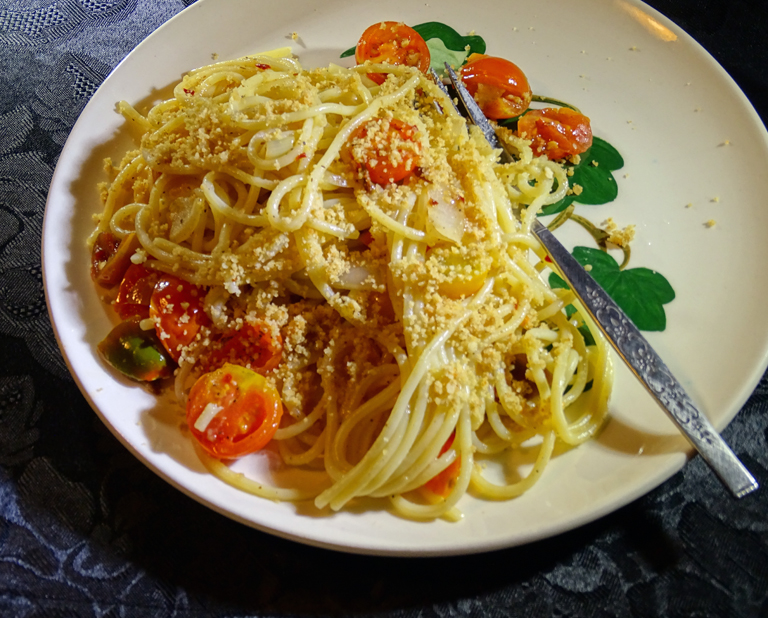
plate of noodles and roasted cherry tomatoes
(Photo by Sharon)

You might wonder what food has to do with social media. And writers. I’ll get to that.

Debbie Johansson posted some suggestions — 3 Things Social Media Can Teach Writers — a few years ago. Her advice actually stands the test of time. I especially like number three, do what feels comfortable.

I’ve been thinking about social media a lot lately, mostly because I’ve just taken on the job of social media officer for Sisters in Crime Chicagoland. And I’ve become website “updater” for a local theater group. But these are hardly my first forays into the online world. This post marks the end of my tenth anniversary as a blogger. In fact, my experience goes back to AOL and The Well, both accounts I’ve long since given up. But I learned a lot during the pre-web, internet bulletin board days of screechy dial-up connections.

For one thing, I learned being online is a great way to be in touch with people who are nowhere near my pretty rural outpost where getting out of my snow-drifted driveway has always been a challenge this time of year. The best change to come from covid, as far as I’m concerned, was the proliferation of work-from-home options. But when you are at home most of the time, social media is a substitute for the coffee klatch, the water cooler conversation, the quick lunch with friends.

That, I think, is the key to Johansson’s advice to “keep it personal.” I know some people whose real lives are reflected almost completely in their posts. And as an occasional food writer, I’ve probably shared more meal photos than are strictly necessary. (I told you I’d get back to food.) But I enjoy good eats, at home or away, and I don’t mind sharing those with my friends. I even shared recipes at work. Maybe I’ll share a recipe or two here sometime.

I also had a column about travel, which led to my last couple of Midwest travel posts.

And that’s the other key to being real in social media — regardless of the platform. Share what you like and your readers may actually become your friends.

Happy New Year to you! I hope you have wonderful 2023!

À bientôt.

Back on the debate trail

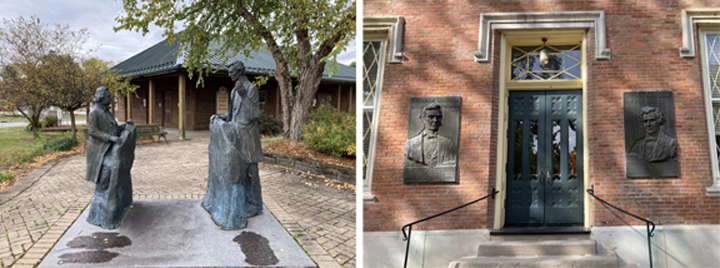
Charleston (left) and Galesburg, Illinois, debate sites. (Sharon’s photos)

A couple of months ago, after I finally took a few photos of the first Lincoln-Douglas debate site in Ottawa, Illinois, and the second one in Freeport, I said I was going to put the seven sites on my “to visit” list. Well, I ticked off two more this month on the way home from a southern road trip.

(Sharon’s photo)

I stopped at Charleston, site of the fourth debate, and Galesburg, site of the fifth debate. No, I’m not taking them in the order they happened. This was the order that worked for my route back home to northern Illinois. I figure I’ll try to do three, six and seven on my next trek south.

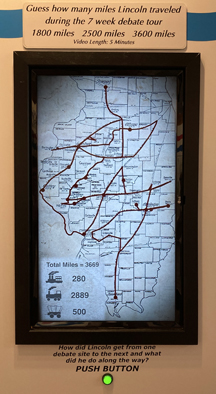
And I don’t expect to log as many miles as Lincoln did while he was on the debate circuit. There’s a map of the whole route, including details about how many miles Lincoln covered via train, boat and wagon at the Charleston museum. (Apparently Douglas didn’t keep track as closely.)

My only advance research for the sites was finding them on my GPS. I was expecting small parks, like the surroundings of the two sites I’d already seen. Each of those has some relatively new signs explaining what went on back in 1858. But neither of these sites is in a park.

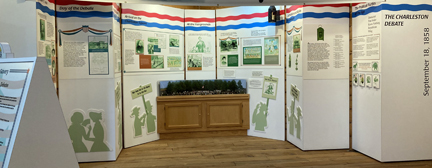
Charleston’s debate site is at the Coles County Fairgrounds, and its statues of the debaters are the most accessible of the ones I’ve seen so far. They stand at the corner of a little museum that features some hands-on exhibits, as well as a little theater that shows a short film at the press of a button.

(Sharon’s photo)

The political nature of the debates is clear, with red white and blue bunting and colors throughout the room. But the location was considered especially friendly to Lincoln, where his stepmother, Sarah Bush Lincoln, and other family members still lived. The local hospital bears her name.

(Sharon’s photo)

In Galesburg (also the home of Carl Sandburg, but that’s another story), the debate was held outside Old Main, a building that was finished in the summer of 1857 on the campus of Knox College. There are no statues to commemorate the debate, but on the east side of the building large, bronze plaques of each candidate frame doorways into the building. (The handicapped entrance is on the west side of the building.)

Inside along the hall, several signs and photos illustrate the history of the college, as well as the significance of the debate. And in a small room on the left from the debate doorway is the Lincoln Chair room. The chair is the one Lincoln sat in while waiting for the debate to begin.

(Sharon’s photo)

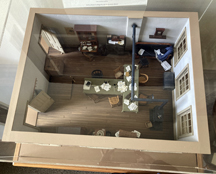
The room also houses a collection of memorabilia from the debate, as well as from the life of the 16th president. Across from the doorway sits a detailed miniature of the law office Lincoln shared with William H. Herndon in Springfield, Illinois. There are also a variety of images — posters, photos– and a small statue of Lincoln on a bookshelf.

Historical note: One of Knox College’s graduates was Hiram Rhodes Revels, who would become the first African-American U.S. Senator and the president of Alcorn University in Mississippi.

To the left of the miniature, is the window Lincoln and Douglas climbed through to reach a platform that was built for their debate. It blocked the door between the plaques, making the window the only access for the debaters. The effort, according to a small sign near the window, led to Lincoln’s remark, “At last, I have gone through college.”

À bientôt!