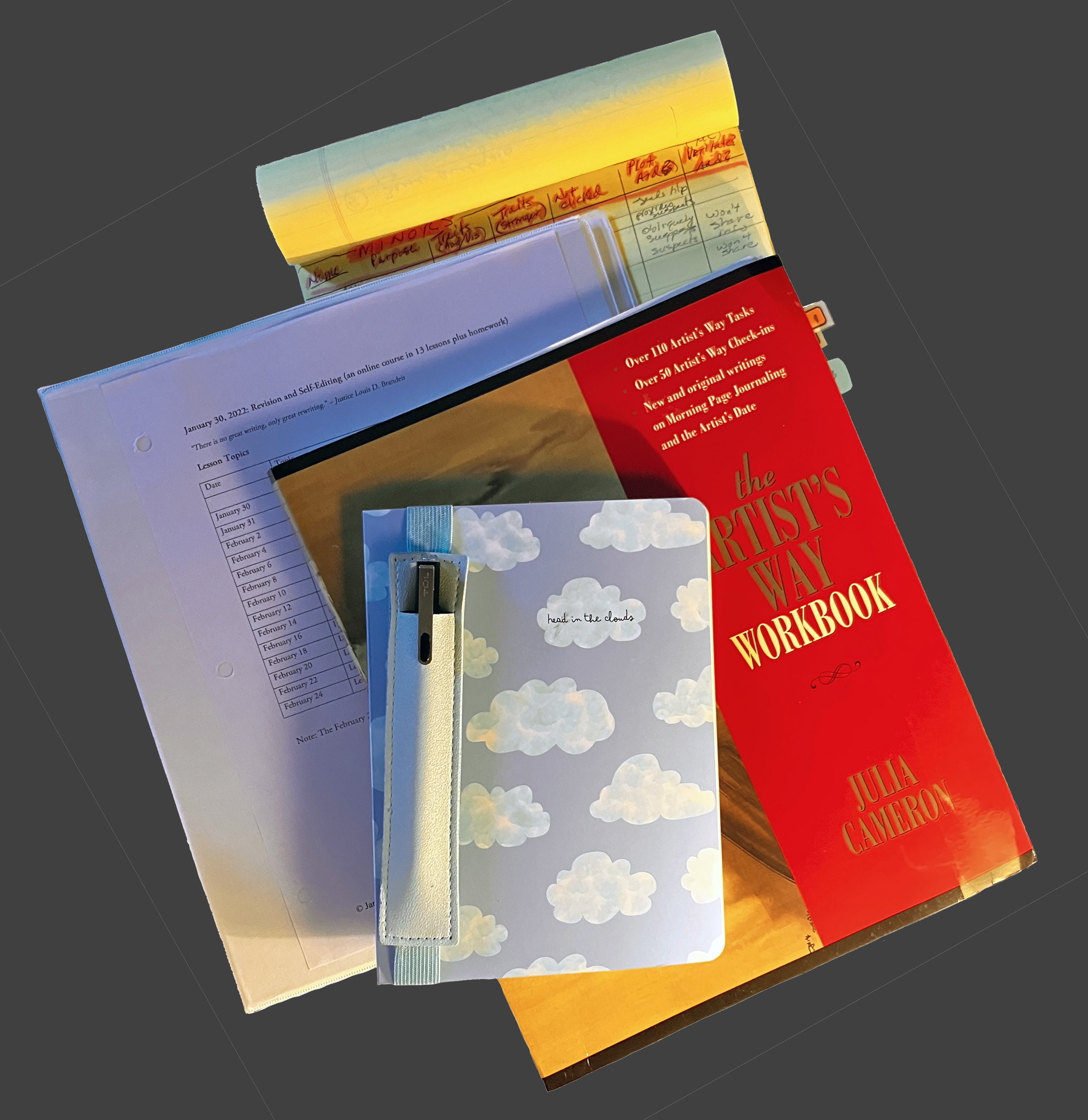
Artist’s dates are an idea from Julia Cameron, the woman who created a movement with her book, The Artist’s Way. I started working through her twelve-week course earlier this year. (I wrote about it and a few other things in February.) Cameron suggests solo artist’s dates weekly to refill the well we draw on when we create art–whether visual or verbal. She describes them as solo dates “to do something fun.”
While the idea of doing something fun is certainly a good one, I spend enough time on my own. I’ve been an “empty nester” and a widow for quite a few years now, so doing things by myself is my norm. Planning more time alone isn’t as much fun for me, especially when I’m trying to feed my inner artists.
This month, though, I had a chance to do a couple of group crafts, and I realized those are my perfect artist’s dates.
(Sharon’s photo)
The first one was at our local writing group’s “Day Camp for Big Kids.” One of our newest members is a professional graphic artist and a crafter. She offered to lead us through a process that recycles junk mail into folios. She imagined they would be ideal for snippets of stories, inspirational pictures, character notes and anything else we might want to save for stories we’re working on. She also said we could take them to conferences or other gatherings to hold business cards and other small memorabilia we might pick up there.
At the rate I’m going this year, I may actually have a completely revised (and possibly ready to pitch) manuscript.
Since I started working through Jim Jackson’s revision and self-editing process in January, I’ve made it through the total read-through and identified the major changes. Yes, I’ve been at it since January, but it’s not like I’ve put in eight hours a day on the project. In fact, I did some rough math and calculated I’ve actually spent a little more than week and a half on this project. If I didn’t have other “retirement” activities, I might have finished the entire revision by now.
But I do have other activities and, frankly, I don’t plan to drop too many more of them. I have a couple of board memberships that will expire next spring, but by then I may have a solid revision plan to work with.
I wandered through January making small “resolutions” as I thought of them. Having got most of my calendars figured out–I’m pretty sure the pocket sized one will get bigger for next year–I started some new projects. About three quarters of the way through January, I decided to get serious about jumping on my treadmill more often. I even bought some colored stars (I guess those gold stars in school really impressed me.), and I have a star on six out of seven days through February. Moving a bit every day is a good plan for me.
I also found The Artists Way workbook that I bought a couple years ago and let sit on an end table in the TV room. I started reading, and I’ve been doing morning pages for a full month! I remember hearing about them years ago from friends who swore by them. But I didn’t really understand the way they are supposed to work until I read the explanation in the workbook. I love the way they help me unload the mind-mess I wake up with. I’ve taken to ending them with a couple–just a couple–of things I want to accomplish that day or the next. I really believe writing one or two daily goals made me more productive. I certainly feel more productive this month.
I will say some of the thinking of Julia Cameron, the author of what I’ve taken to abbreviating TAW, was initially off-putting to me. She speaks in a language of recovering: recovering a sense of safety, of identity, of power, and so on. To me recovering implies a loss, or a sickness of heart. But when I substituted discovery for recovering, the book felt much homier and welcoming to me. I think I’m discovering more of the artist inside that I’ve always know was there, but that I didn’t give time to because I was busy working and trying to be a good mom to my kids. Now that I’ve retired, I feel like discovering the potential I’ve left dormant for decades.
I haven’t done as well on the solo artist’s dates as I might. That’s partly because my schedule is already so full. I have writing groups six days a week, three book clubs every month, plus a couple of study groups, the League of Women Voters, and a social gathering or two. And I feel that many of those events feed the artist in me without going it alone. I’ll try to fit in some of the prescribed dates, but I’m not too worried about that.
And the other thing I started doing was working through a revision course I took four years ago through the Sisters in Crime Guppy chapter. Our former president Jim Jackson taught the course. (He teaches three and I’ve taken them all.) I used the same novel I’m working on now for the course, but I knew I wouldn’t be able to focus a lot of attention on it because my “big volunteer job” started about half way through the course.
I kept every note, though, and I printed them out at the end of January and started with the first step–rereading the entire draft. This time, I learned so much more than last time! With nothing competing for my time and attention, I was able–finally–to discover that I won National Novel Writing Month (NaNoWriMo) with the first draft because, as a pantser, I just wrote words as they came to me. The point of NaNo was to get 50,000 new words in the 30 days of November. I did that the year I drafted this novel, but only because I wrote whatever came to mind at any given writing session.
Reading through this time, I realized how much is way out of order, how much is backstory and info dumps that don’t need to be in the story, and where the big and small plot holes are. I also made a list of all the scenes in the book. I got into the early triple-letters (AAA, BBB, etc.). I’m working on my list of minor characters as I close out February. Because I wrote them as I thought of them, in previous revision attempts I fixed some minor problems without fixing the big ones. As soon as I finish the “character census,” I’ll make a new scene chart and put the scenes in the right order and start by fixing the plot problems
I can’t believe how much fun I’m having finding the problems in the story. And knowing I’m building a strong plan for my revision.
I’m not so foolish as to believe I’ll be creating a “perfect” draft this time around, but I think it will be good enough–with help from my critique partners–to try to shop it to an agent again. I really wasn’t ready for the pitch in October, but I wanted to give it a try. She, rightly, declined it. But the pitch was great for practice and I know the general outline of the plot and characters are good, or she wouldn’t have told me to send her pages. One of the big changes that will come in this draft is losing a good chunk of the very beginning of the story. Maybe I’ll have good luck next time, too.
December has flown by in my life. I didn’t get as much writing done as I’d hoped, although this week I started a wonderful adventure at the Winter Writing Sanctuary, offered by British woman named Beth Kempton. My friend Sharon Michalove, a writer I see nearly every day in online writing groups, spent a week last winter with Beth and told several of us about it Monday.
It’s only Wednesday (yes, New Year’s Eve), and I’ve already made some critical discoveries about the main character in a novel I’ve been trying to revise for several years now. I don’t think Sharon M. knew just how serendipitous her suggestion would be for me.
For example, the novel’s working title is Lovely, Dark and Deep. I took it from Robert Frost’s poem, “Stopping by Woods on a Snowy Evening” by Robert Frost. Amazingly (to me), that poem opened the welcome message for this year’s sanctuary.
The main character, after a few trial names, is now called Beth. That decision I made long before I ever heard of Beth Kempton.
The exercises–really suggestions for things a writer might try this week–have focused on the palette of winter, greens, greys, golds and more. And each day’s inspiration has taken me down a path, when I journey as my character, has helped me really understand my MC much better than I have. I wrote the first draft of this novel for National Novel Writing Month (a now defunct event) in 2020. Other things have gotten in the way of my finishing–including wonderful family distractions this month. But just a couple of hours these past few days have really helped me get back into the revisions.
I’m going to be distracted yet again with an impromptu family dinner tonight, and, no doubt with some surprise that will come up tomorrow. But I think this week’s writing exercises will make the beginning of 2026 much more productive than I imagined.
So, farewell to 2025. It was a great writing year for me.
{In fact, I added a page to this website to post my short stories. Check out “Blood on the White Rose” if you haven’t read it yet.)
And hello to 2026. I’m hoping for more of the same.
When my friend Mary and I headed north for the Wisconsin Writer’s Association conference in Stevens Point on Oct. 2, little did I know that I would cross one of the first hurdles in any writer’s life. A hurdle that would make me want to be glued to my keyboard for the rest of the month. But various life events and previous commitments turned into the second hurdle between me and the end of this particular race.
So, about that first hurdle. Writers who want to try to be traditionally published must first find an agent. I figured I’d try one of the practice pitches offered early in the conference, and, what the heck, I signed up for a real pitch, too. That was on the last day of the conference and I figured it would be good practice, too. I’d have a chance to talk to an agent about what she was looking for, how I could improve my pitch, what I should plan for next time.
But as I paused in my initial statement — my mostly bungled log line and a bit about the plot and main characters — she grabbed a sheet of paper and said, “Here’s what you do next.” She actually asked to see my first fifty pages! I was astonished. (And to save us both embarrassment in case I trip over the next hurdle, I’ll keep her anonymous.)
But, after accepting congratulations from Mary and other friends at the conference, I got home and started polishing those pages. I’m still polishing with just a few days left to send them to the agent.
They were rougher than I remembered. And all in first person.
I made the decision months ago but didn’t act on it because I was busy with some short stories that had more immediate deadlines. So, on Oct. 6, I started changing the point of view from first to a version of third person, variously called “limited” or “close” third person.
I’ve had to fight two tendencies as I’ve revised. One battle is to keep away from the omniscience that is, frankly, a natural POV for me. I’m making it up, after all, so of course I know everything. The other is to let the reader into the head of my POV characters. In other words, I have to convince myself it’s okay to read my character’s minds and share all that with my readers.
Another problem was a decision to add the second POV, and that meant moving a discussion from a later chapter up closer to the front. Based on what my wonderful critique partners have said–independently, I might add–that seems to be my roughest chapter.
I should be working on that, not this, right now. I only have a few more days to get it done.
But in all the years I’ve been writing this blog, this is one of the key moments in my fiction career. And it may go no further if the agent who decided to take a chance on fifty pages decides they’re too rough for her to take any on. (Fingers crossed she likes them.)
Still, an agent let me cross the first hurdle and I’m still aglow with joy and hope. This is my celebration. (I’ll break out some wine after I send the pages.)