Unbooking the overbooked

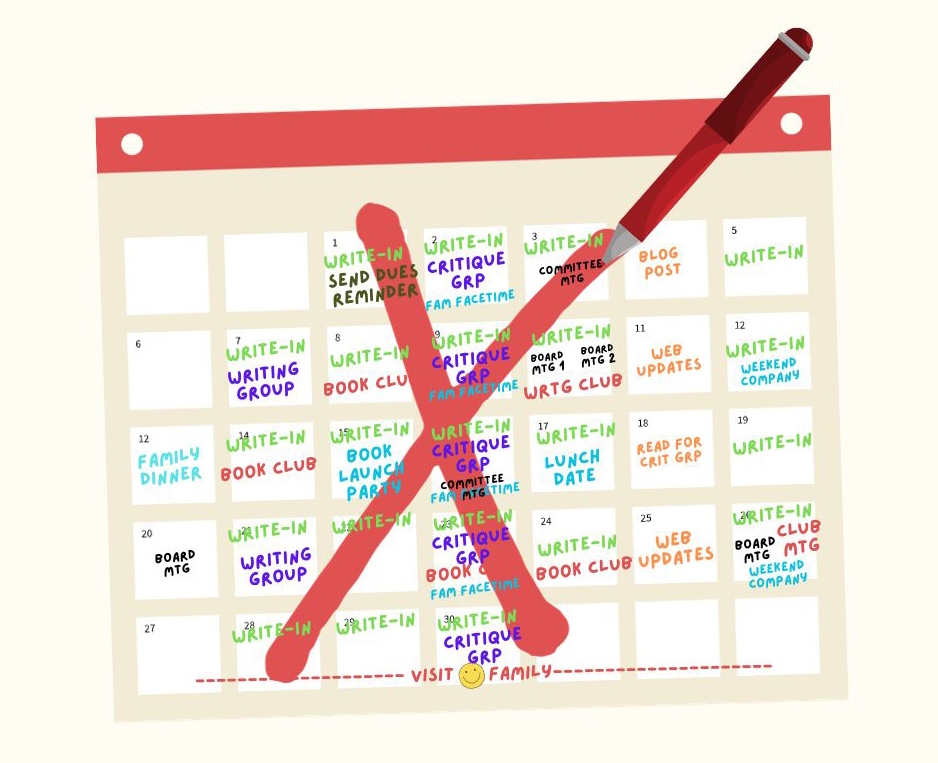
(Sharon’s Canva illustration)

When I tiptoed into retirement two years ago this month, I was worried about how to use my time. I wanted to finish my first novel. That was my number one goal. The thing I’d wanted to do since the day I got my library card. The thing I’d put off until the kids were grown, and until I didn’t have to go to work every day.

I already had a few volunteer posts I expected to continue, and some travel plans. But writing was supposed to be my reward for all those years of working.

Now, on the second anniversary of my mostly-retirement, I’m feeling as if I never quit working. I still haven’t finished revising that novel. I’m going through my travel budget at a much faster rate than I expected. And I’ve said “yes” to far too many requests for help.

I’ve decided it’s time to peel away some of the layers of volunteerism, back off on the travel plans and actually finish the revisions.

I didn’t find it easy to establish a schedule after retiring, but I was just getting into a nice routine when I took on another volunteer job. I hadn’t expected it, but from February through the beginning of May, I had to put everything on the back burner for it. Between learning the duties, adding the trip it required, and my usual summer conference, I was effectively off my newly-established schedule until mid-June.

When I got home, I found myself playing catch-up with my other volunteer roles, and working in some family time. Somehow, despite a few stabs at revision, I never really got back to the novel until November. And by then it was National Novel Writing Month again.

I expected the second year of that demanding task to be better, which in some respects it was. But I tacked another conference onto the East Coast trip that the volunteer job required. And I added a second summer conference. This year my novel went on the back burner again starting in February. I anticipated being off track for at least three months.

But since one of my volunteer boards went haywire in May, it’s been one IED explosion after another right into this month. I’ve been losing sleep and definitely not working on my novel.

But how to pick up the pieces of my schedule despite the unexpected challenges?

I came across a book called Start Finishing by Charlie Gilkey (who also puts many of his tips on his website, Productive Flourishing). Sure, there are plenty of “self help” books, and I read a few about organizing and time management right after I retired. I was looking for help in creating — and keeping — a routine that is self-imposed.
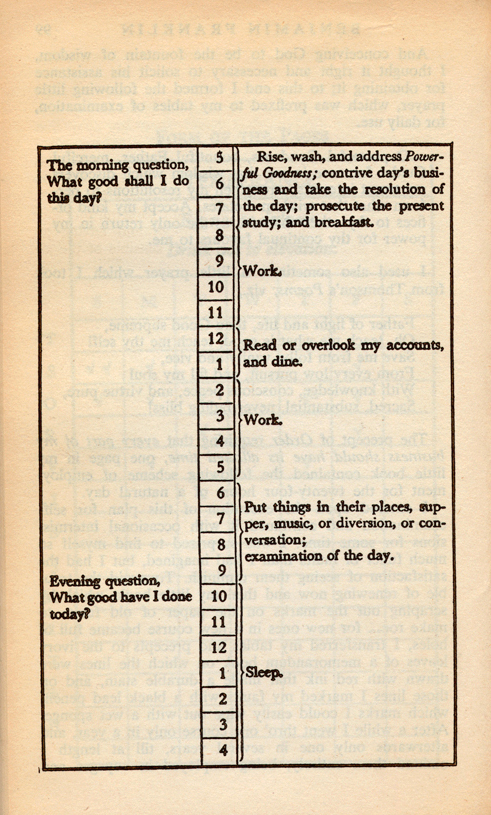
(image from Poor Richard’s Almanack)

I think Gilkey’s project-based approach to making time to do what he calls “your best work” may work for me. My goal right now is to set boundaries. I have to do that if I really plan to get my novel revised and into the world And then I have to keep doing it with all the NaNo novel drafts I created in the last ten years of my full-time work life.

To that end, I’m adopting Ben Franklin’s daily schedule as a template. I’m not likely to get up at five in the morning to start my day, but we’ll see.

And don’t ask me to volunteer for anything. In fact, I’m finishing the year (or the term) with several of my volunteer boards right now, and I don’t plan to sign on again.

Now, to the revisions!
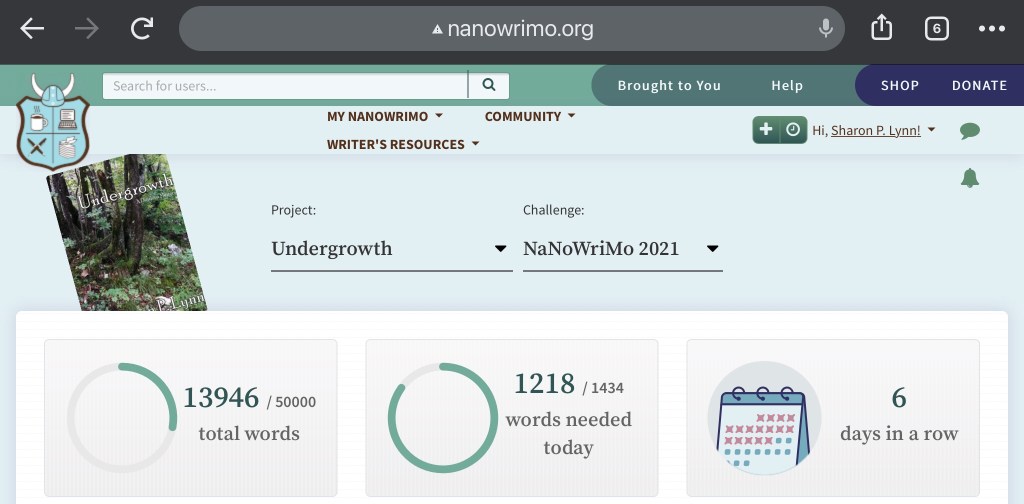
Six days and counting

Last Monday I kicked off NaNoWriMo with a big day and I’ve been riding the wave of a couple of thousand banked words since then. With an extra hour on my clock today, I hope to move a little further ahead.

I’ve been learning some things about my main character and her friends in the past week. It’s the first draft of the second novel in a series I have planned. I just finished the first draft of the first book at the end of October, so I’m not dreaming up new characters — well, some are new; victims and suspects, mostly — or a new environment for them to live in.

Restraining myself from going back to make changes in the first novel has been one of my biggest battles. I did allow myself to make minor changes — the name of one character is different now, so I let myself do a global replace a couple of days ago. But otherwise, I’ve been making notes.

So far, I haven’t had to bring in the ninjas — a suggestions from some of my long-time NaNo friends about what to do when you get stuck. I know I have to raise the stakes for the main characters as the book goes along, but I don’t think ninjas really fit into my plot.

I’ve also got a rough idea of where I’m going. As I turn more and more into a “plantser,” I find a tendency to figure out what I need and make a Scrivener notecard for it, then go back to what I was doing. I still start out knowing very little. I like to keep things surprising — even to me.

Instead, I’ve been focusing on deepening my understanding of my characters’ back stories. I have a feeling I’ll be doing a bit of that today. I tend to put that in files that aren’t part of the novel, so I don’t usually include that in my word count. It’s legit, but they won’t be part of the final draft anyway, so why put them there now? We’ll see where I am come Nov. 30.

I hope you’re having a good NaNo! And remember, use all the words.

À bientôt

Writing groups vs. writers’ groups

(Photo/fauxels from Pexels)

I just spent a stormy Tuesday evening writing with a half-dozen friends. I am always productive when I write with others. I also do pretty well when I write alone, but when I’m with others I’m less inclined to let myself get distracted from the work.

And, based on our conversation after we wrote, I realized I hadn’t articulated my goal in extending the invitation for others to meet me at a library. I know others aren’t as starved for writing time as I am. I’m working to change that, and joining groups that write is one way to do it.

For the last several years, my first writers’ group has hosted a writing day once or twice a year. We have a space we can use that’s big enough for our group members plus 10 or 12 additional writers. We’ve never needed more space than that. And it was perfect for social distancing the last few times we hosted the day.

We gather about 8:30 a.m. and pack up about 4:30 p.m., with an hour at lunch to socialize. That’s a pretty long day for writing, and twice a year seems like enough for something like that.

And since COVID, the magic of online meeting software has opened up a world of write-ins through two groups I belong to — Sisters in Crime and Mystery Writers of America. They, of course, offer far more than some group write-ins.

I’m not sure why I like write-ins so well. The only thing I can attribute it to is the years I’ve spent writing in newsrooms. I used to have trouble writing in those wide open spaces, but once I learned what background noise I could ignore and what I needed to heed, I found buckling down at deadline was easy.

I can imagine that there is something to having all those people involved in the same effort that put us all on a writing “wave length.” And I like that wave length.

As for critique groups, those have a different aim, and I haven’t done as well in them. I think part of my problem has been not having enough time to devote to reading others’ work — on top of the paucity of my own writing time. But I realized immediately that reading is a crucial part of critique groups. I dropped out of them.

Now that I’m moving to full time fiction writing, I think I might be ready to become a better member of a critique group. All I need to do is figure out a critique group formula that works for me … and a handful of other writers, too.

In the meantime, I’m taking full advantage of my writing groups. And I love the folks who are willing to write together.